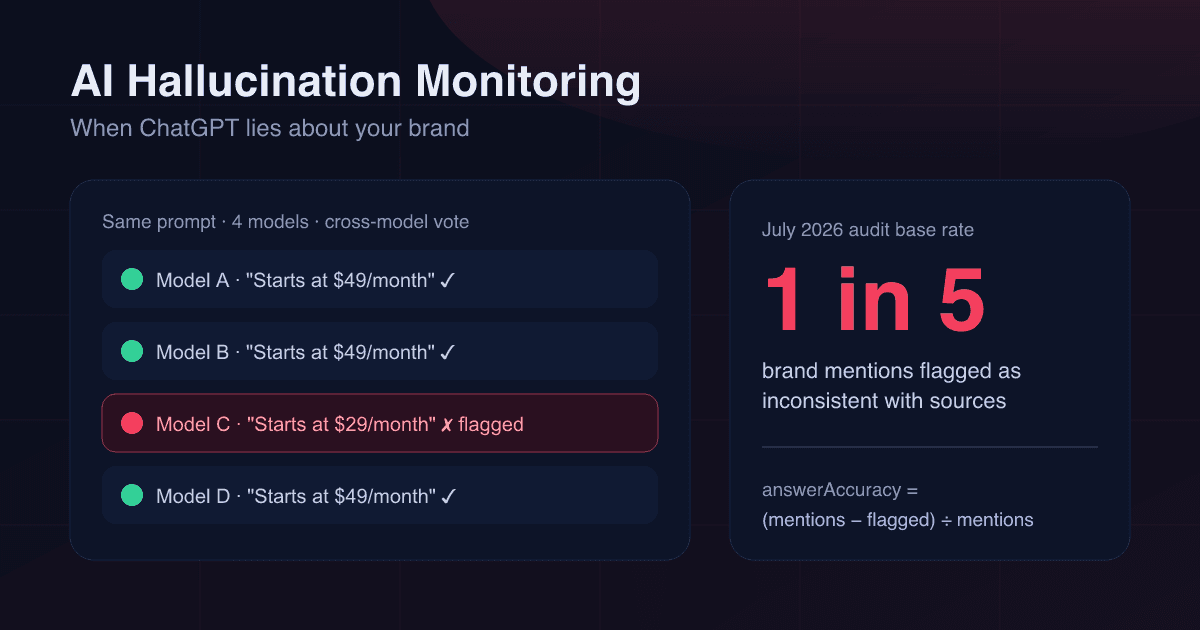
AI Hallucination Monitoring: When ChatGPT Lies About Your Brand
LLMs confidently invent pricing, features and even founders. How to detect brand hallucinations — and the multi-model voting method that verifies them.
AI hallucination monitoring is the practice of systematically checking what LLMs claim about your brand — pricing, features, availability, history — and catching the claims that are false. It matters because AI assistants don't caveat their errors: ChatGPT will state a discontinued plan's price, invent an integration you never built, or attribute your company to the wrong founder with exactly the same confidence it states your real facts. Visibility tools tell you whether you appear in AI answers. Almost none of them tell you whether what the AI said is true. This post covers what brand hallucinations look like in real scan data, why they happen, and the multi-model voting method we use to detect them at scale.
What is a brand hallucination?
A brand hallucination is a confident, factual-sounding claim an AI assistant makes about a brand that contradicts the brand's own current, authoritative information.
The definition has two important edges. First, confident: the model doesn't flag uncertainty, so a user has no signal that the $29/month plan being quoted was discontinued a year ago. Second, current: most brand hallucinations aren't invented from nothing — they're real facts from 2024 served as if it were today. Stale truth is still a hallucination when it's presented as the present.
What we see in real scan data
We publish weekly GEO audits built from real multi-model scans, and the error rates are consistently higher than people guess. In our July 2026 audits, 17.6% of Framer mentions and 21.6% of Beehiiv mentions were flagged as potentially inconsistent with a cited source — roughly one in five brand mentions carrying a claim that didn't check out against the models' own grounding.
Across scans, the errors cluster into three patterns:
- Pricing drift — the most common by far. Plans get renamed, repriced, or retired, and models keep quoting the old numbers for months.
- Feature invention — the model pattern-matches from competitors: if most tools in your category have an API, the model may confidently say you do too.
- Identity confusion — founders, funding, and company history get cross-wired with similarly-named companies or with competitors that co-occur in the same articles.
Why it happens
Three mechanics, all structural:
- Training cutoff vs. your roadmap. Parametric memory is frozen at training time. Everything you've shipped, repriced or killed since then is invisible unless retrieval fills the gap.
- Retrieval that misses. When a model does search the web, it may land on an outdated review, a scraped pricing aggregator, or a competitor's comparison page instead of your site. The citation looks authoritative; the fact is wrong.
- Plausibility over accuracy. LLMs generate the most likely answer, not the most verified one. For a mid-sized brand with thin coverage, the statistically likely answer is often an interpolation from the category — which is how invented features are born.
How to detect hallucinations at scale: multi-model voting
You can't fact-check thousands of AI answers by hand, and a single model can't referee itself. Our method — the same one that powers the answerAccuracy metric in SeenForAI — uses the models against each other:
- Run the same prompt across multiple LLMs. Every scan sends each buyer-style prompt to up to 7 models (ChatGPT, Claude, Gemini, Perplexity, Doubao, Kimi, DeepSeek).
- Vote on agreement. For each prompt we compute an agreement rate: the share of successfully-responding models that mention the brand. Failed runs are excluded — a model that errored is neither agreement nor disagreement.
- Judge the conflicts. When answers diverge, a separate judge model reviews the conflicting claims and classifies the severity: none, low, medium or high. Divergent phrasing is fine; divergent facts about pricing, features or availability are not.
- Flag conservatively. If a conflict is judged medium or high, every mention of the brand under that prompt is flagged as a potential hallucination — including the models that got it right. A prompt with contested facts is a prompt you need to look at.
From there, answer accuracy is a simple, defensible formula:
answerAccuracy = (brand mentions − flagged mentions) / brand mentions × 100
hallucination rate = 100 − answerAccuracy
The point of publishing the formula is that you can audit it. A hallucination metric you can't inspect is just another confident claim.
What to do when you find one
Correcting a hallucination means correcting the sources the model retrieves:
- Your own domain first. A canonical, dated pricing page and a plain-language facts/FAQ page are the cheapest authoritative sources you control. Models cite them when they exist.
- Wikipedia and Wikidata. For founder, funding and history errors, these are the entities models trust most. Fix them with sources, not marketing copy.
- llms.txt. Publish a machine-readable summary of what your product is and costs. It's a low-cost way to hand crawlers the ground truth.
- Third-party listings. G2, Crunchbase and category directories feed retrieval constantly. Stale listings are hallucination fuel.
- Re-scan and verify. A correction isn't done when you publish it — it's done when the models stop repeating the error. Monitoring closes the loop.
For the broader measurement picture — Share of Voice, sentiment and citations alongside accuracy — see Measuring Your Brand in LLMs and the full GEO guide.
FAQ
What is a brand hallucination? A confident, factual-sounding claim an AI assistant makes about a brand — pricing, features, availability or history — that contradicts the brand's own current, authoritative information.
How common are AI hallucinations about brands? In our July 2026 public audits, 17.6% of Framer mentions and 21.6% of Beehiiv mentions were flagged as potentially inconsistent with a cited source — roughly one in five.
How do you detect brand hallucinations at scale? Run identical prompts across multiple LLMs and compare answers. A judge model classifies disagreements; serious factual conflicts get flagged. Single-model checks can't referee themselves.
Can you stop an LLM from hallucinating about your brand? You can't patch the model, but you can fix its sources: canonical pricing pages, Wikipedia, llms.txt, and current third-party listings. Models re-retrieve continuously, so fixes surface within weeks.
Is hallucination monitoring different from AI brand monitoring? Yes. Brand monitoring measures whether you appear and how you're framed. Hallucination monitoring checks whether what's said is true — the part most visibility tools skip.
Check what AI is saying about you
One in five mentions carrying a wrong claim is not a tail risk — it's the base rate. Run a free AI visibility check to see how ChatGPT, DeepSeek, Kimi and Doubao describe your brand today, or see pricing for continuous hallucination monitoring across all 7 models.
Further reading
More Posts
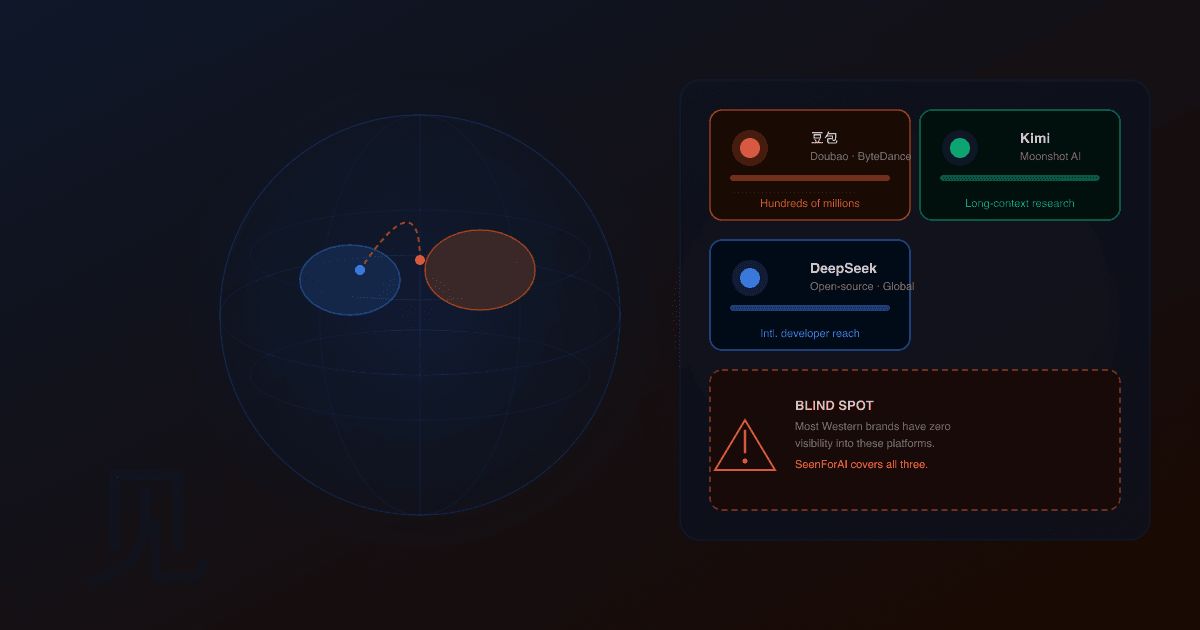
Why Chinese LLMs Matter for Global Brands
Doubao, Kimi, and DeepSeek serve hundreds of millions of users — most Western brands have no idea what these models say about them.

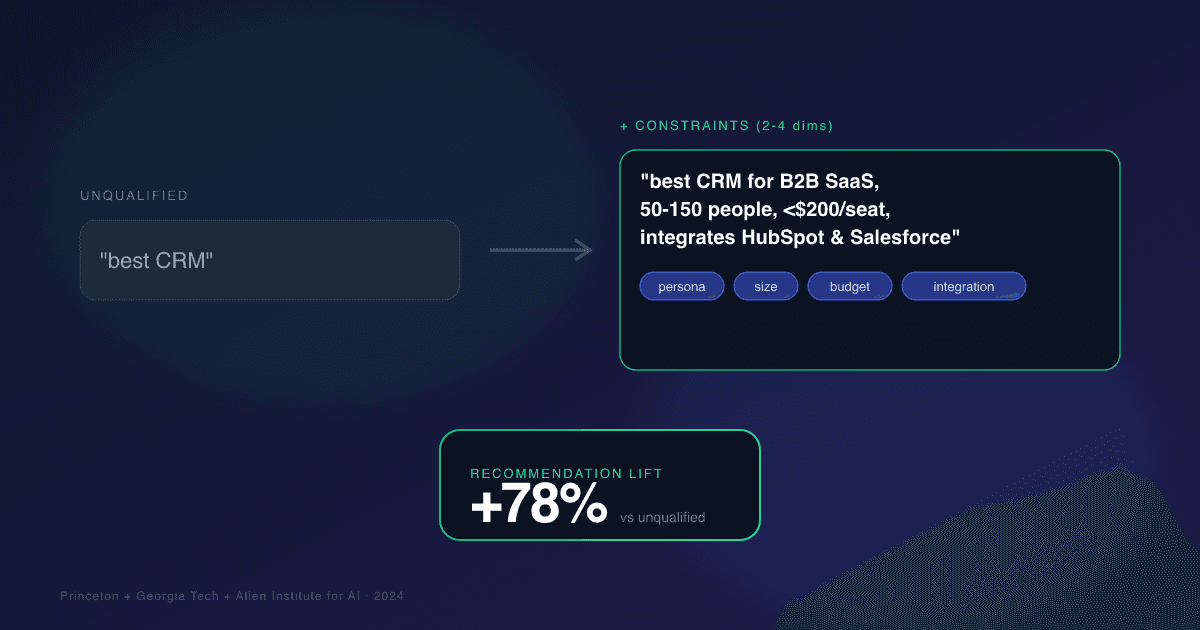
Constraint Injection: The Princeton Trick That Lifts AI Brand Recommendations 78%
A 2024 study from Princeton, Georgia Tech, and the Allen Institute for AI shows that adding 2-4 constraints to a prompt makes LLMs surface specific brand recommendations 78% more often. Here's how to use it.
Being Seen in the AI Era
Why we built SeenForAI — and what it means to be truly visible when AI becomes the primary discovery layer for brands.
Product Newsletter
Stay informed
Receive release notes, and workflow tips from SeenForAI.