How to Rank in ChatGPT: A Measurable 6-Step Playbook (2026)
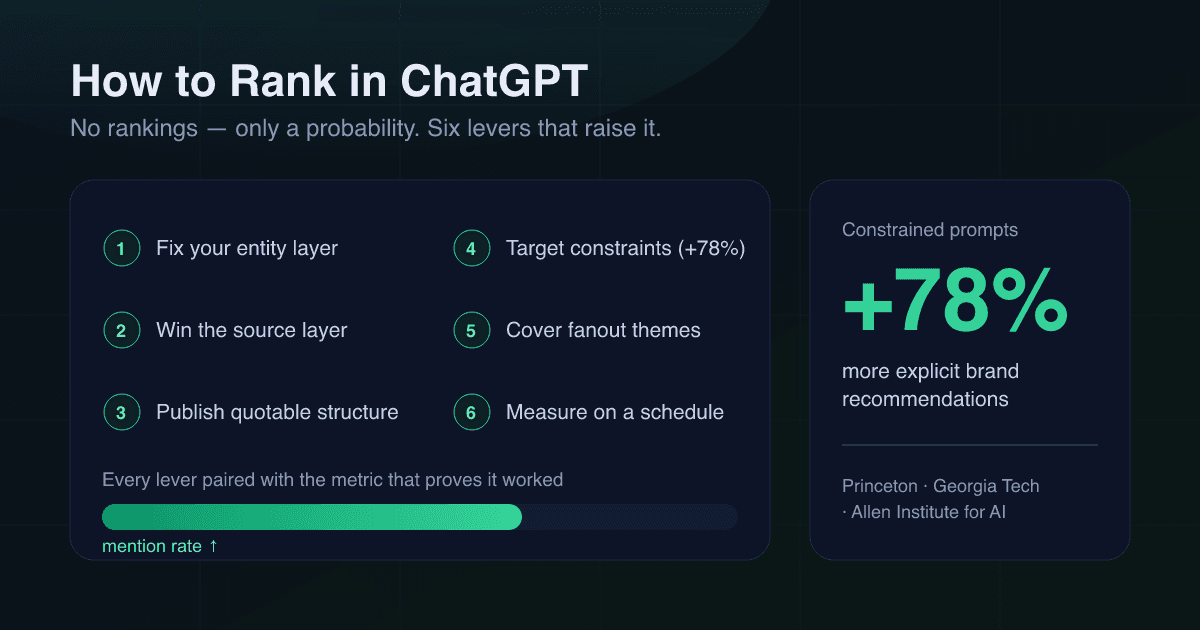
ChatGPT has no rankings — only a probability your brand gets named. Six levers that raise it, with data on what actually moves the needle.
You can't rank in ChatGPT the way you rank in Google — there's no results page, no position 1, no rank tracker. What exists instead is a probability: how often ChatGPT names your brand when a buyer asks a category question. That probability is measurable, and it responds to specific levers. This playbook covers six of them — and, unlike most "how to rank in ChatGPT" lists, pairs every lever with the metric that tells you whether it worked. Tips without measurement are astrology; the whole point of GEO is that you can check.
First, the mechanics in one paragraph: ChatGPT builds answers from parametric memory (the category consensus it absorbed at training time) plus retrieval (live web pages it searches and cites). Memory only shifts when OpenAI ships a new model. Retrieval re-reads the web continuously — which makes it the lever you can move in weeks.
Step 1: Fix your entity layer
Before persuasion comes recognition. ChatGPT has to know — unambiguously — what your brand is, what it makes, and what it costs. That means: a crawlable official site with a plain pricing and features page, consistent naming across the web (one spelling, one category label), correct Wikipedia/Wikidata entries if you qualify, and current listings on G2, Crunchbase and your category's directories. Stale or contradictory entity data doesn't just lower your odds of being named — it raises the odds of being named wrong.
How to verify: ask ChatGPT "what is [your brand] and what does it cost?" across several runs. Wrong answers here are hallucinations you can fix at the source — track your accuracy rate before and after. (We wrote up the detection method in AI Hallucination Monitoring.)
Step 2: Win the source layer, not just your own site
When ChatGPT searches, it grounds answers in a recognizable pool: review sites, Reddit threads, comparison articles, documentation. Your own blog is a minority shareholder in that pool. The work: get reviewed where your category gets reviewed, show up honestly in Reddit threads buyers actually read, and pitch the comparison articles that keep getting cited.
How to verify: citation rate — the share of your mentions backed by a source — and whose domains those citations land on. If your mentions are grounded in competitors' comparison pages, the model is learning your story from someone else.
Step 3: Publish content structured to be quoted
LLMs lift structures, not paragraphs of prose: definition sentences, comparison tables, "best X for Y" lists with reasons, FAQ blocks. A page that answers a buyer question in a liftable shape is retrieval bait in the best sense. Make the claims specific and dated — models increasingly prefer sources that look current.
How to verify: mention rate on comparison prompts ("X vs Y", "alternatives to Z") specifically. This is where structured pages show up first, usually weeks before category prompts move.
Step 4: Target constrained prompts — the 78% lever
The single best-documented finding in GEO research: a 2024 study from Princeton, Georgia Tech and the Allen Institute for AI found that prompts carrying 2–4 constraints ("for B2B SaaS, under $50/seat, integrates with HubSpot") trigger explicit brand recommendations 78% more often than unconstrained ones. Unconstrained prompts return the three most famous incumbents; constrained prompts return whoever actually fits. If you're not the category giant, constrained queries are where you can win now — provided your positioning content states, in plain crawlable text, exactly which constraints you satisfy. Full breakdown in our constraint injection post.
How to verify: split your tracked prompts into constrained vs. unconstrained and compare your mention rates. The gap tells you whether your differentiation is legible to the model.
Step 5: Cover fanout themes, not keywords
When ChatGPT searches, it silently expands your buyer's question into multiple sub-queries — pricing, integrations, alternatives, use cases. Chasing individual sub-queries is futile (research from Surfer found only ~27% of them are stable across runs), but the themes recur. Audit your content against the recurring themes in your category and close the gaps — a missing pricing-comparison page means losing every fanout that fires one. More in Query Fanouts: The Hidden Layer of AI Search.
How to verify: mention rate across prompt variants of the same intent. If you appear for "best CRM" but vanish for "best CRM pricing", you've found the fanout theme you're missing.
Step 6: Measure on a schedule, not on a whim
Every lever above is verified with the same instrument: a fixed prompt set, run repeatedly, scored consistently. Build it balanced — roughly 35% category, 35% comparison, 30% use-case prompts — and never include your brand name in the prompts themselves. Single manual checks are noise: LLM answers vary run to run, so trends only emerge across scheduled scans. This is also the step that catches regressions — a model update can quietly reshuffle your category overnight.
How to verify: this step is the verification. Baseline today, change one thing, watch mention rate, position and Share of Voice move — or not move, which is equally valuable information.
Where to start
Start with the free baseline: run a live AI visibility check — one real category prompt across ChatGPT, DeepSeek, Kimi and Doubao, no signup — and see whether you're in the answer at all. Then work the six steps in order. Steps 1–3 are foundation, step 4 is where challengers beat incumbents, and steps 5–6 are what separates a GEO program from a one-time experiment.
Further reading
Author

Categories
More Posts
DeepSeek GEO: How to Get Your Brand Recommended (2026)
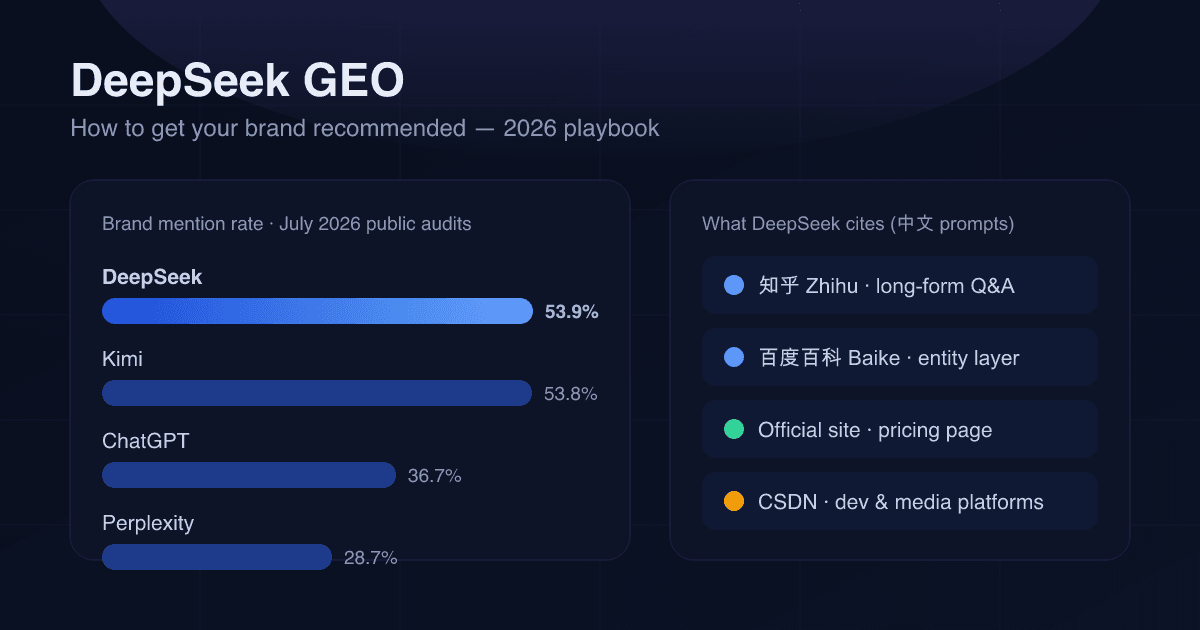
DeepSeek answers millions of product questions daily. Here's how it picks brands to recommend — and a step-by-step playbook to become one of them.

Being Seen in the AI Era
Why we built SeenForAI — and what it means to be truly visible when AI becomes the primary discovery layer for brands.
GEO vs SEO: What You Actually Need in 2026
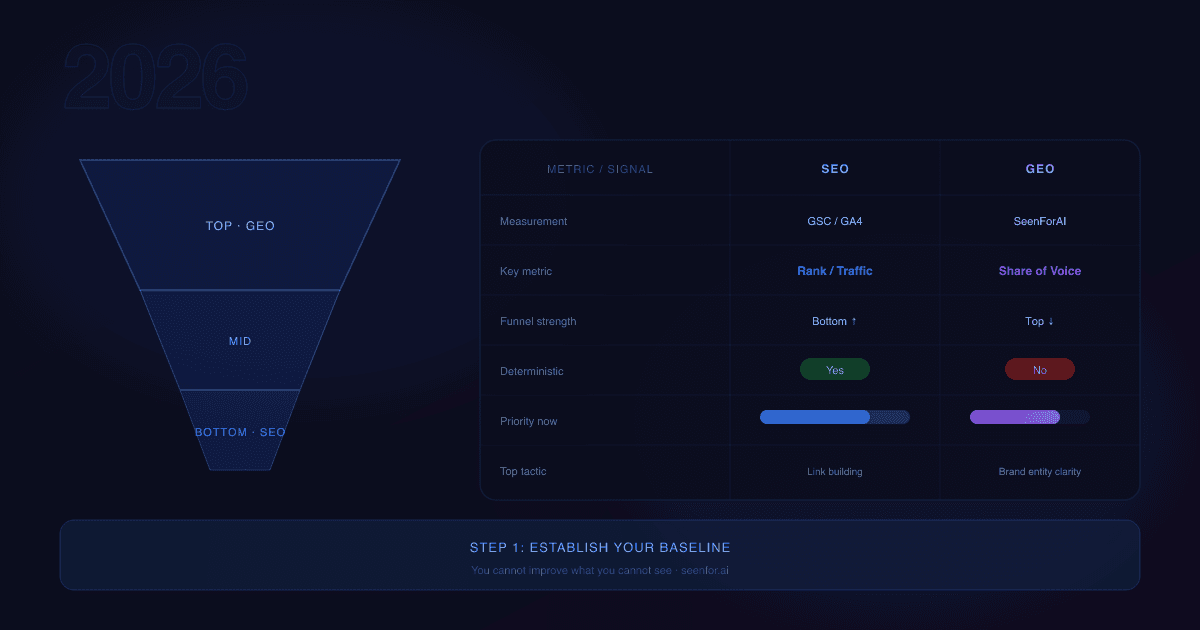
Both still matter, but the investment priorities have shifted. Here's a practical playbook for brand visibility across search and LLMs.
Product Newsletter
Stay informed
Receive release notes, and workflow tips from SeenForAI.