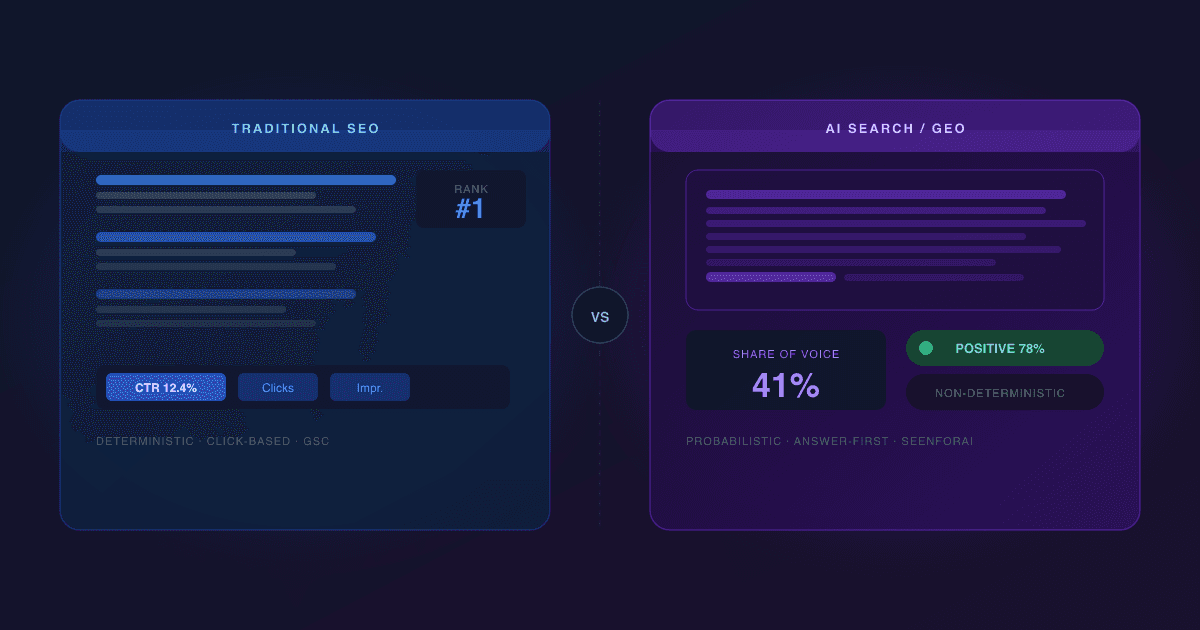
AI Search vs Traditional SEO: What's the Difference?
Rankings and LLM mentions are two separate games. Here's how they differ — and why marketers need to play both.
For the past two decades, the model was simple: write content, build links, rank on Google, get clicks. SEO had its quirks and algorithm updates, but the underlying mechanism was stable. Users queried, Google ranked, users clicked.
That model is fracturing. Not because search is dying — it isn't — but because a second discovery layer is emerging alongside it, operating on entirely different logic.
How Traditional Search Works
When you publish a webpage, Google's crawlers find it, index it, and score it against hundreds of signals (authority, relevance, freshness, user experience). When a user types a query, Google returns a ranked list of links.
Your job in SEO is to win that ranking. The metrics that tell you how you're doing: impressions, clicks, click-through rate, average position. The key insight is that rankings are deterministic per query — type the same query on the same day and you get roughly the same results.
The business model is the click. The SERP is a list of doors. Your job is to be the door the user opens.
How AI Search Works
LLMs — ChatGPT, Claude, Gemini, Perplexity — work differently at every level.
There is no index to rank against. Instead, models are trained on large corpora of web text, then often augmented with real-time retrieval (RAG) to pull in recent content. When a user asks a question, the model synthesizes an answer from that training and retrieval context.
The output isn't a list of links. It's prose. Often there are no links at all. When citations appear, they're typically one or two sources surfaced as supporting evidence — not a ranked list of alternatives.
Results are non-deterministic. Ask ChatGPT "what's the best CRM for small teams" today and again tomorrow, and you may get meaningfully different answers. The model is sampling from a probability distribution, not reading from a fixed index.
Sentiment is embedded in the answer. A search result is neutral — it's just a link with a title. An LLM answer comes with framing: "Brand X is widely regarded as…", "Some users find Brand Y's interface confusing…". The model's tone and framing of your brand shapes how the user perceives you before they ever visit your site.
The Zero-Click Shift Keeps Accelerating
Featured snippets started the zero-click problem — answers surfaced directly in the SERP that reduced the need to click through. LLMs push this much further. A well-answered ChatGPT response means the user may never need to visit anyone's website at all.
This matters more for awareness and consideration queries than for transactional ones. "What tools do growth teams use for LLM monitoring?" gets answered without a click. "Buy SeenForAI Growth plan" still requires a visit. The top of the funnel is where LLM visibility is most consequential.
Citation ≠ Ranking, and Ranking ≠ Citation
Here's where the two systems diverge in a way that catches most teams off guard:
You can hold the #1 organic position for a keyword and never appear in an LLM answer about that topic. Your content ranks well with Google's algorithm, but the model either didn't train heavily on it, doesn't retrieve it, or simply synthesizes an answer from other sources.
The reverse is equally true: a brand with modest SEO presence can appear consistently in LLM answers if it's mentioned frequently across authoritative sources, explained clearly, and associated with the right categories in the model's training data.
Ranking and LLM presence are correlated but not equivalent. They require different optimization strategies and different measurement tools.
The Attribution Gap
Even when an LLM mentions your brand and the user does visit your site, you won't see it in your referral traffic data. LLM-driven visits typically appear as direct traffic. There's no UTM, no referrer header from ChatGPT.
This creates a measurement gap that most marketing teams haven't solved: you can have significant LLM-driven brand awareness with zero visibility into it from your current analytics stack.
A Dual-Strategy Framework
Traditional SEO and GEO (Generative Engine Optimization) address different parts of the funnel and require different signals:
| Traditional SEO | AI Search / GEO | |
|---|---|---|
| Mechanism | Crawl → rank → click | Train → retrieve → synthesize |
| Output | Ranked link list | Synthesized prose answer |
| Key metric | Organic traffic, position | Share of Voice, mention rate |
| Deterministic? | Mostly yes | No |
| Measurement tool | Google Search Console | SeenForAI, dedicated LLM trackers |
| Funnel position | All stages, strongest at bottom | Top and mid funnel |
SEO remains essential for bottom-of-funnel queries — product comparisons, pricing pages, transactional searches. GEO matters most where users are forming initial opinions: category discovery, brand awareness, "what should I even be considering" research.
Treating these as competing priorities misses the point. They're parallel systems serving overlapping but distinct user needs. Teams that only optimize for one will have blind spots in the other.
The measurement gap is the most urgent practical problem right now. GSC covers your search presence comprehensively. Your LLM presence, unless you're actively measuring it, is completely dark. SeenForAI was built to close that gap — daily monitoring across seven LLMs, with Share of Voice, sentiment, and citation data in one dashboard.
Further reading
More Posts
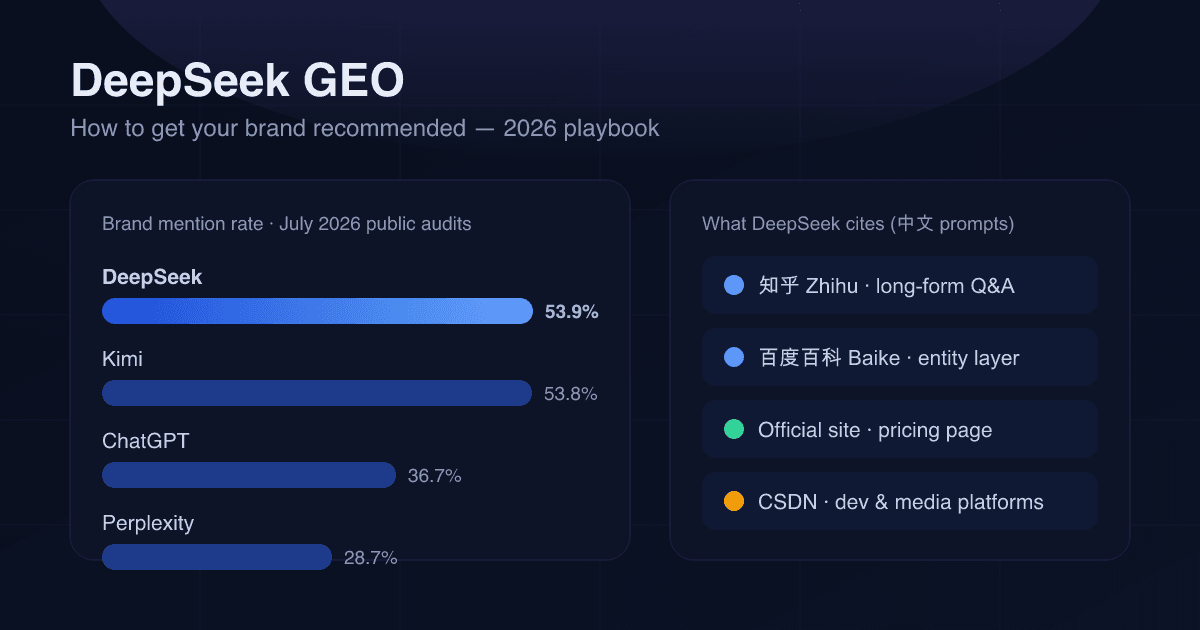
DeepSeek GEO: How to Get Your Brand Recommended (2026)
DeepSeek answers millions of product questions daily. Here's how it picks brands to recommend — and a step-by-step playbook to become one of them.

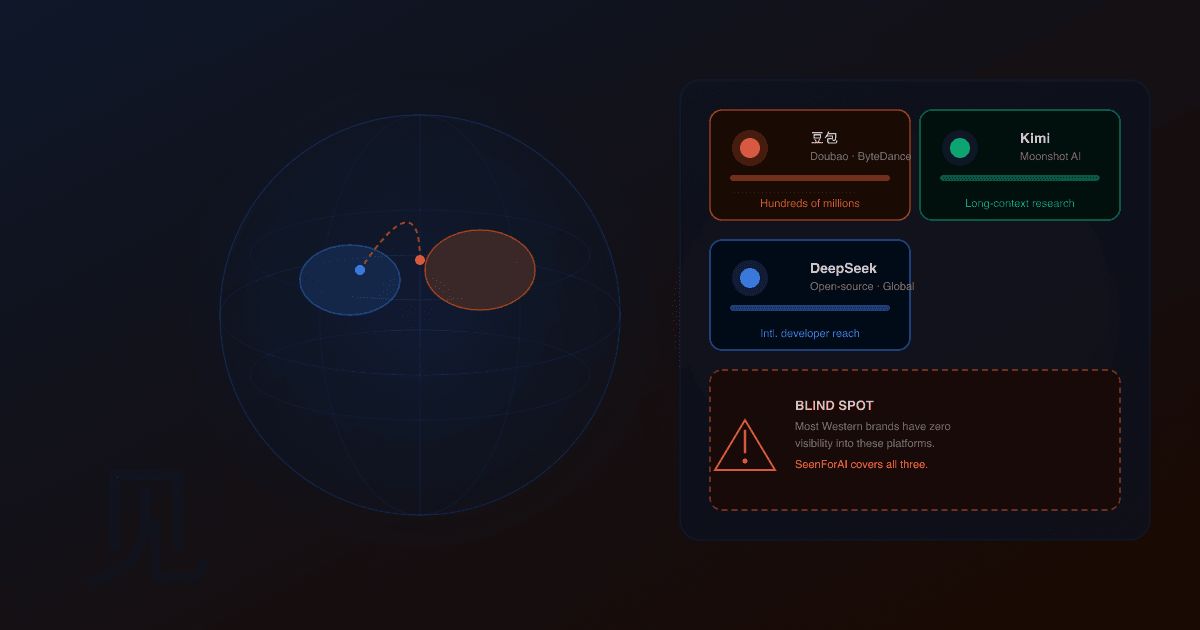
Why Chinese LLMs Matter for Global Brands
Doubao, Kimi, and DeepSeek serve hundreds of millions of users — most Western brands have no idea what these models say about them.
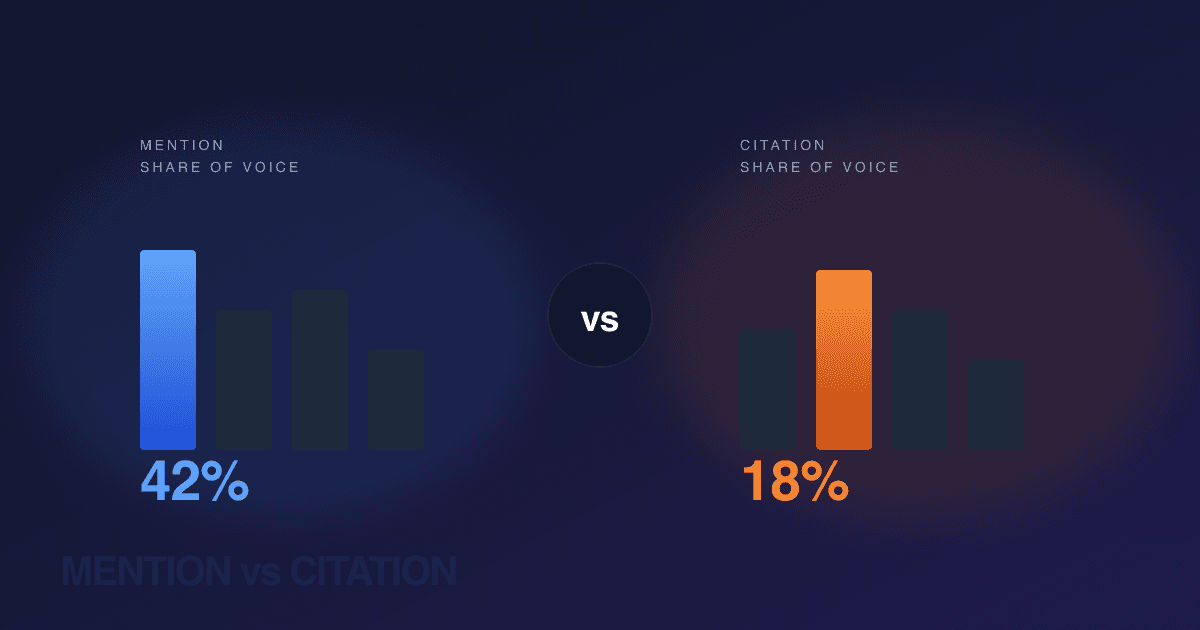
Mention vs Citation: The Share of Voice Split Most GEO Dashboards Get Wrong
ChatGPT mentions your brand in prose but cites your competitor's docs underneath. Which signal counts? Both — but they tell you completely different things, and most dashboards only show one.
Product Newsletter
Stay informed
Receive release notes, and workflow tips from SeenForAI.