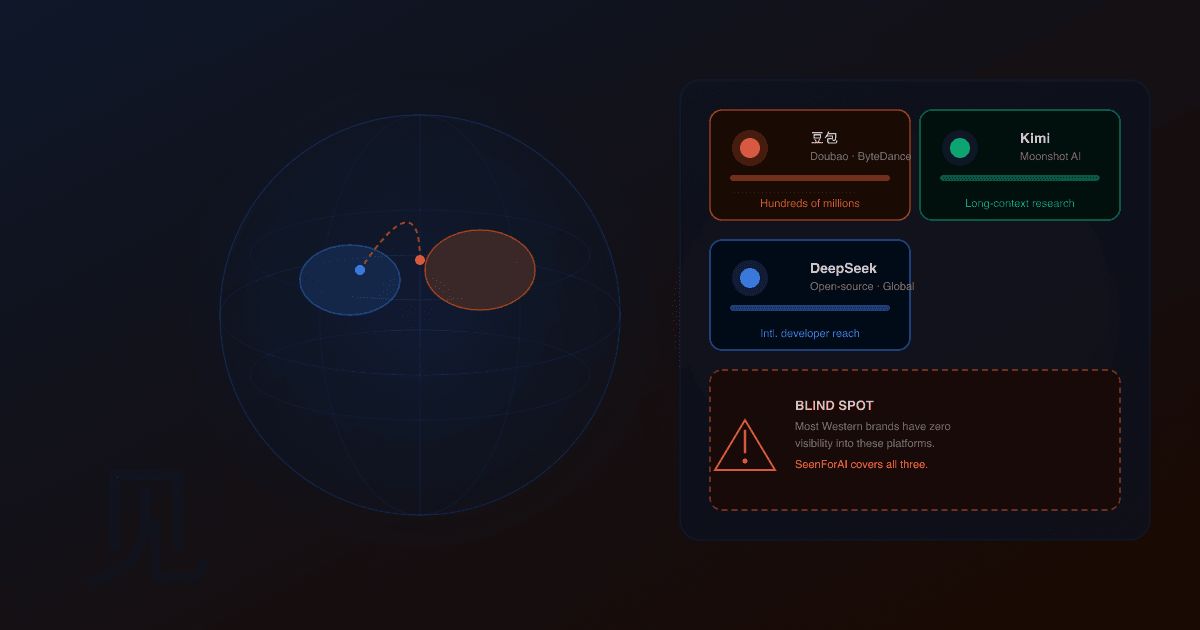
Why Chinese LLMs Matter for Global Brands
Doubao, Kimi, and DeepSeek serve hundreds of millions of users — most Western brands have no idea what these models say about them.
Ask most Western marketing teams which LLMs they monitor for brand presence, and you'll hear the same list: ChatGPT, maybe Claude, maybe Gemini. Ask them about Doubao, Kimi, or DeepSeek, and you'll get a blank stare.
That blind spot is a problem — not just for brands selling into China, but for any brand with a global audience.
The Chinese LLM Landscape
Three platforms dominate Chinese-language AI assistant usage:
Doubao is ByteDance's LLM product — the same company behind TikTok and the largest short-video platform in the world. It has grown aggressively since launch and is deeply integrated into ByteDance's broader ecosystem. For context: ByteDance has over a billion active users across its products.
Kimi is built by Moonshot AI and has earned a reputation for handling long-context documents and detailed research tasks. It's a preferred tool among Chinese professionals doing in-depth product comparisons and vendor evaluation.
DeepSeek gained significant international attention with its open-source releases and strong benchmark performance. It's used both by Chinese-speaking users natively and by developers and researchers internationally.
These aren't obscure tools. They are major AI assistants with active user bases making real decisions — including decisions about which software to buy, which services to use, and which brands to trust.
Chinese LLMs Reach Beyond China
The reach of these platforms extends well past China's borders. Chinese diaspora communities in the United States, Canada, Australia, the UK, and Southeast Asia use these tools as their primary AI assistants. A Chinese-American founder comparing project management tools might ask Doubao before they ask ChatGPT. A Taiwanese marketing team evaluating SaaS vendors might use Kimi.
For any software company, agency, or B2B brand with international aspirations, Chinese-speaking users are part of the addressable market — even if the product is primarily English-language.
What Western Brands Are Missing
The core problem is one of total darkness. Most Western brands have:
- No knowledge of whether Doubao even has an opinion about their product
- No visibility into how Kimi describes them in comparison to competitors
- No alerting when DeepSeek starts spreading a hallucinated claim about their pricing or features
This isn't hypothetical. LLMs hallucinate brand facts regularly, and Chinese LLMs train primarily on Chinese-language sources — meaning the content that shapes their perception of a Western brand is often different from what shapes ChatGPT's view. English press coverage that gets your brand into ChatGPT's training data may have limited penetration into Doubao's.
The result: a brand can have strong, accurate representation on Western LLMs and simultaneously be described inaccurately, unfavorably, or not at all on Chinese LLMs — with no one at the company aware of the gap.
Different Training Data, Different Perception
Chinese LLMs are trained on corpora that skew heavily toward Chinese-language content. Product reviews written in Chinese, tech forums like V2EX and Sspai, Chinese-language media coverage — these are the sources that shape how Doubao or Kimi understands a brand.
A Western SaaS tool that's been extensively covered in English by TechCrunch and Product Hunt may have minimal Chinese-language coverage, which means the model has thin, potentially inaccurate context for it. The model might understate the product's capabilities, attribute wrong pricing, or simply describe it as less established than competitors with stronger Chinese-language presence.
Sentiment patterns can also diverge. Chinese users may emphasize different use cases, value different features, and express concerns about different aspects of a product compared to the English-language user community. A brand with overwhelmingly positive sentiment on ChatGPT might find more mixed or critical framing on Kimi — not because the product is worse, but because the sources the model trained on reflect a different user perspective.
SeenForAI's Chinese LLM Coverage
SeenForAI was built with Chinese LLM coverage as a first-class feature, not an afterthought. The platform monitors Doubao and Kimi alongside ChatGPT, Claude, Gemini, and Perplexity — running your brand's prompt set daily across all seven and surfacing results in a unified dashboard.
This lets you compare your Share of Voice across LLMs, catch divergent sentiment between Western and Chinese platforms, and get hallucination alerts when Doubao or Kimi states something factually wrong about your product.
It's the only Western brand monitoring tool that covers the full LLM landscape rather than just the English-language slice of it.
If your brand has any exposure to Chinese-speaking users — through a global product, an international team, or just a user base that includes the diaspora — the question isn't whether Chinese LLMs matter. It's whether you know what they're saying about you right now.
Get a free brand scan to find out. Doubao and Kimi are included.
Further reading
More Posts
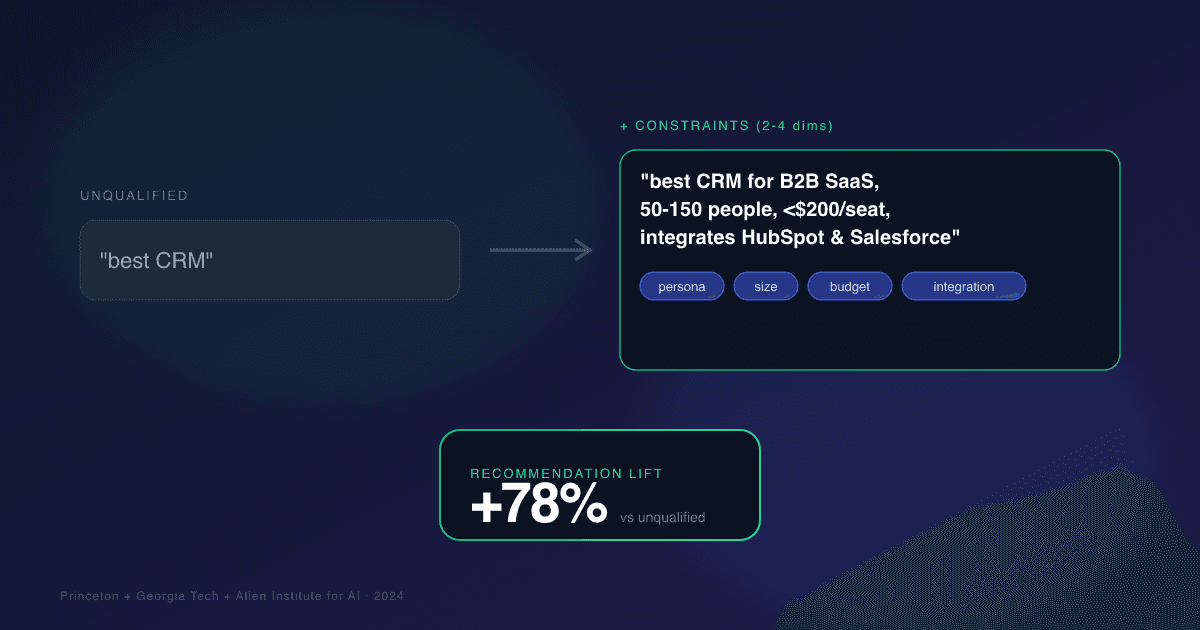
Constraint Injection: The Princeton Trick That Lifts AI Brand Recommendations 78%
A 2024 study from Princeton, Georgia Tech, and the Allen Institute for AI shows that adding 2-4 constraints to a prompt makes LLMs surface specific brand recommendations 78% more often. Here's how to use it.

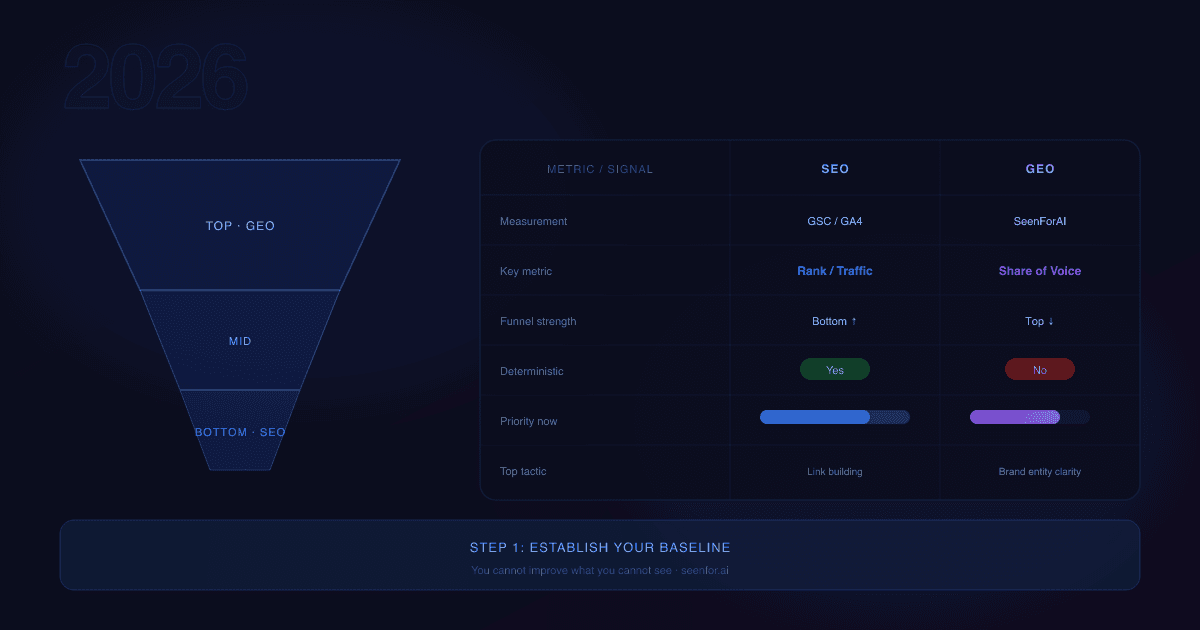
GEO vs SEO: What You Actually Need in 2026
Both still matter, but the investment priorities have shifted. Here's a practical playbook for brand visibility across search and LLMs.
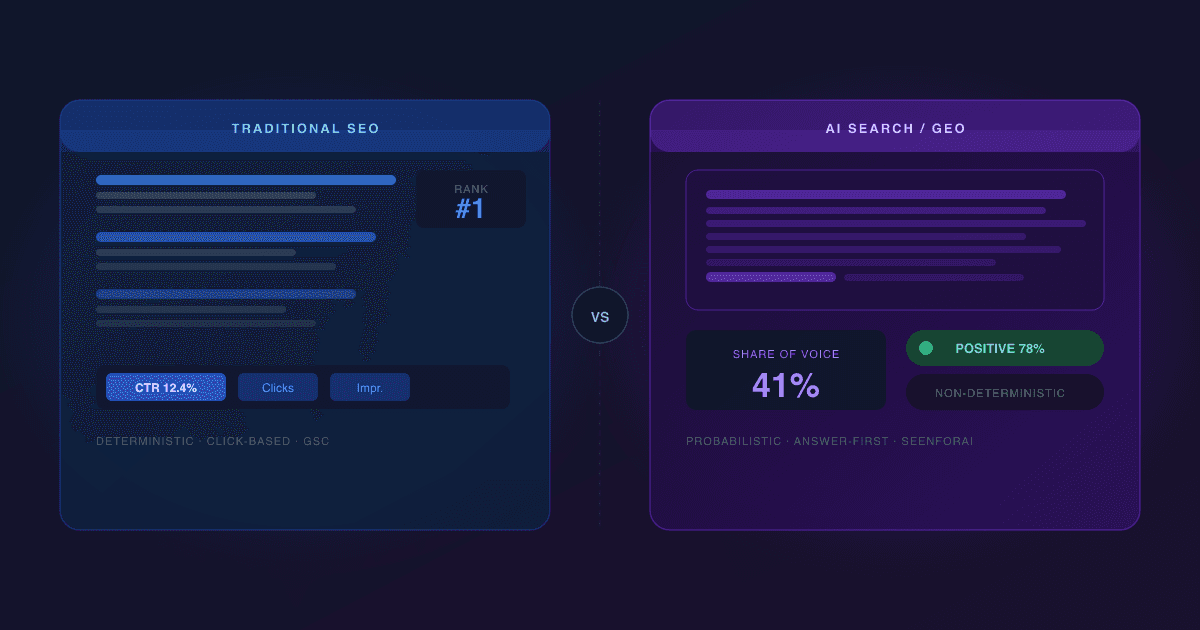
AI Search vs Traditional SEO: What's the Difference?
Rankings and LLM mentions are two separate games. Here's how they differ — and why marketers need to play both.
Product Newsletter
Stay informed
Receive release notes, and workflow tips from SeenForAI.