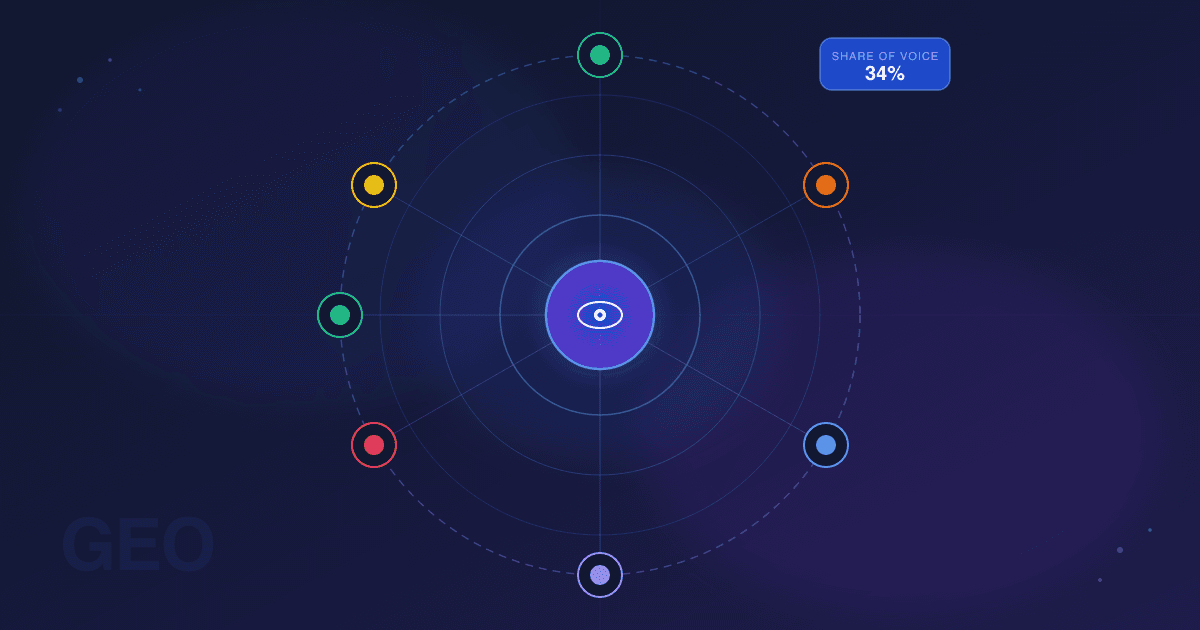
What Is GEO (Generative Engine Optimization)?
GEO is the practice of optimizing your brand to appear in LLM-generated answers. Here's why it matters and how to measure it.
Every few years, a new discovery layer rewrites how brands get found. First it was directories, then search engines, then social algorithms. Now it's LLMs — and most brands are still measuring the wrong thing.
Generative Engine Optimization (GEO) is the practice of optimizing your brand so it appears — accurately and favorably — in answers generated by large language models like ChatGPT, Claude, Gemini, and Perplexity. If SEO was about ranking on page one, GEO is about being part of the answer itself.
How LLMs Surface Brands Differently
Type a query into Google and you get ten blue links. Type the same query into ChatGPT and you get a synthesized answer — often with no links at all, or just one or two citations buried at the bottom.
This changes the game in three important ways:
1. There is no page two. In search, ranking #4 still gets some traffic. In an LLM answer, if your brand isn't mentioned, you're invisible. There's no second screen for the user to scroll to.
2. Results are non-deterministic. Ask ChatGPT the same question twice and you may get different answers. The LLM isn't reading from a ranked index — it's sampling from a probability distribution shaped by its training data, retrieval layer, and prompt. Your brand might appear 60% of the time, or 10%, and without measurement you'd never know.
3. Sentiment is baked into the answer. A search result is neutral — it's just a link. An LLM answer comes with context: "Brand X is known for…", "Users often complain that…", "The best option is typically…". How the model frames your brand matters as much as whether it mentions you.
Why Your Current Analytics Miss This Entirely
Google Search Console, GA4, and SEMrush are built on one assumption: the user clicks a link. But ChatGPT referrals often show up as direct traffic (or don't show up at all), because the user got their answer without clicking anything.
You have no impression data for LLM answers. There is no equivalent of GSC's query report. If someone asks Perplexity "what's the best AI visibility tool" and your brand is never mentioned, that gap is completely invisible in your current stack.
This is the measurement problem GEO solves.
The Core Signals That Drive GEO
LLMs are trained on the web and augmented with retrieval — so the inputs to GEO are rooted in what's publicly written about your brand. The key signals:
Brand entity clarity. Does the web clearly know what your brand does, who it serves, and what category it belongs to? Ambiguous or contradictory signals (inconsistent descriptions across your site, Wikipedia, and third-party coverage) dilute your LLM presence.
Authoritative third-party citations. LLMs weight coverage from trusted sources heavily. Press coverage, analyst mentions, and respected community posts matter more than your own blog.
Structured, factual content. FAQ pages, comparison tables, and well-structured "what is X" content give LLMs clean passages to quote. Vague marketing prose doesn't extract well.
Consistent brand mentions across the web. Frequency matters. A brand that appears across dozens of independent sources trains the model toward inclusion. A brand that only appears on its own domain is effectively invisible.
Mention Rate and Share of Voice: The Core GEO Metrics
In search, your metric is ranking or organic traffic share. In GEO there are two related numbers, and it's worth knowing the difference.
Mention Rate is the simpler one — how often the model mentions you at all.
Share of Voice (SoV) is competitive — out of all the brand-class names showing up across those answers, what fraction is yours.
Mention Rate = brand mentions ÷ total prompts
Share of Voice = brand mentions ÷ (brand mentions + competitor mentions)
When you haven't configured competitors yet, SoV defaults to the Mention Rate value so the dashboard still shows a number. Once you add competitors, SoV becomes the more honest long-term metric — your Mention Rate can rise simply because the LLM started naming more tools per answer, while SoV only moves when you actually gain ground.
If you run 100 prompts across ChatGPT that a buyer in your category might ask, and your brand appears in 34 of those answers, your Mention Rate is 34%. If competitors collectively show up 66 times, your SoV is 34 / (34 + 66) = 34%. If competitors show up 100 times across the same prompts (because each answer names two or three rivals), your SoV drops to 34 / (34 + 100) ≈ 25% — even though your Mention Rate hasn't moved.
Both numbers are meaningful on their own — and even more meaningful when you track them over time (are they trending up or down?) and compare against specific competitors (are they taking share from you?).
Measuring GEO With SeenForAI
Manual measurement — literally prompting ChatGPT every day — doesn't scale. You'd need to run hundreds of prompts across seven LLMs, parse unstructured text for brand mentions, assess sentiment, and track trends over time. That's a full-time job before breakfast.
SeenForAI automates this. Every day, it runs your customized prompt set across ChatGPT, Claude, Gemini, Perplexity, Doubao, Kimi, and DeepSeek. It extracts:
- Share of Voice per LLM and in aggregate
- Sentiment — how each model frames your brand (positive, neutral, negative, or mixed)
- Citation tracking — which URLs the LLMs are pulling when they mention you
- Hallucination flags — when a model says something factually wrong about your brand, verified by cross-model voting
The result is a daily dashboard where you can actually see your GEO performance — not guess at it.
If you've never measured your brand's LLM presence before, the free scan at seenfor.ai will show you your current Share of Voice across four LLMs. Most brands are surprised by what they find.
GEO isn't a replacement for SEO — it's the layer above it. Getting the click still matters, but increasingly, brands need to win the answer before the click ever happens.
Further reading
More Posts
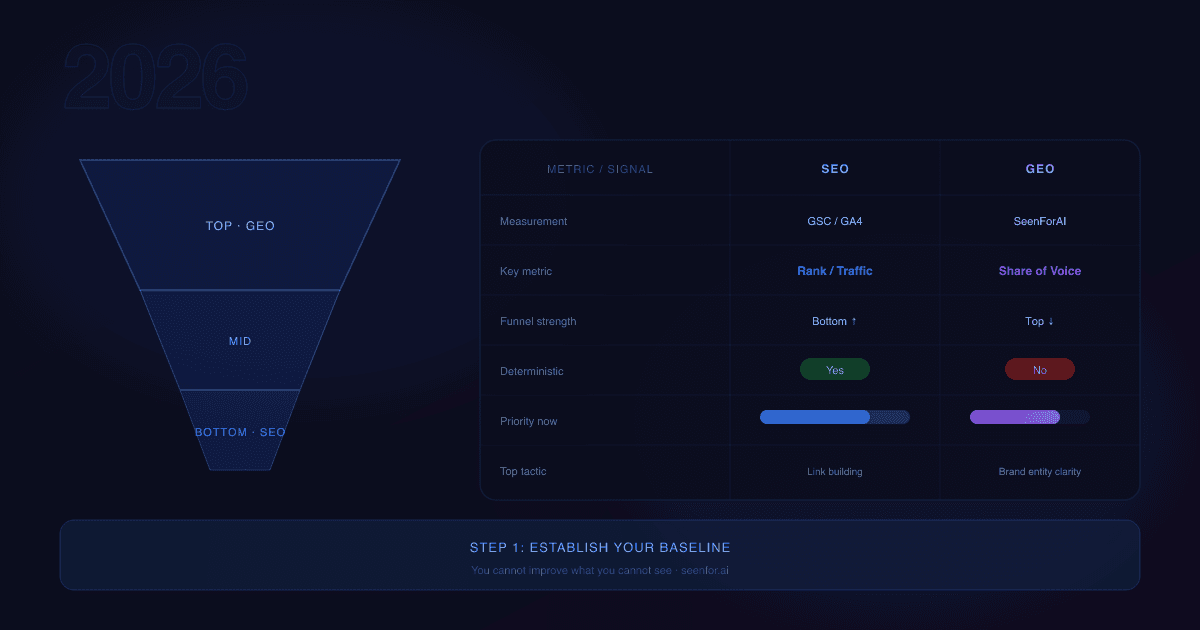
GEO vs SEO: What You Actually Need in 2026
Both still matter, but the investment priorities have shifted. Here's a practical playbook for brand visibility across search and LLMs.

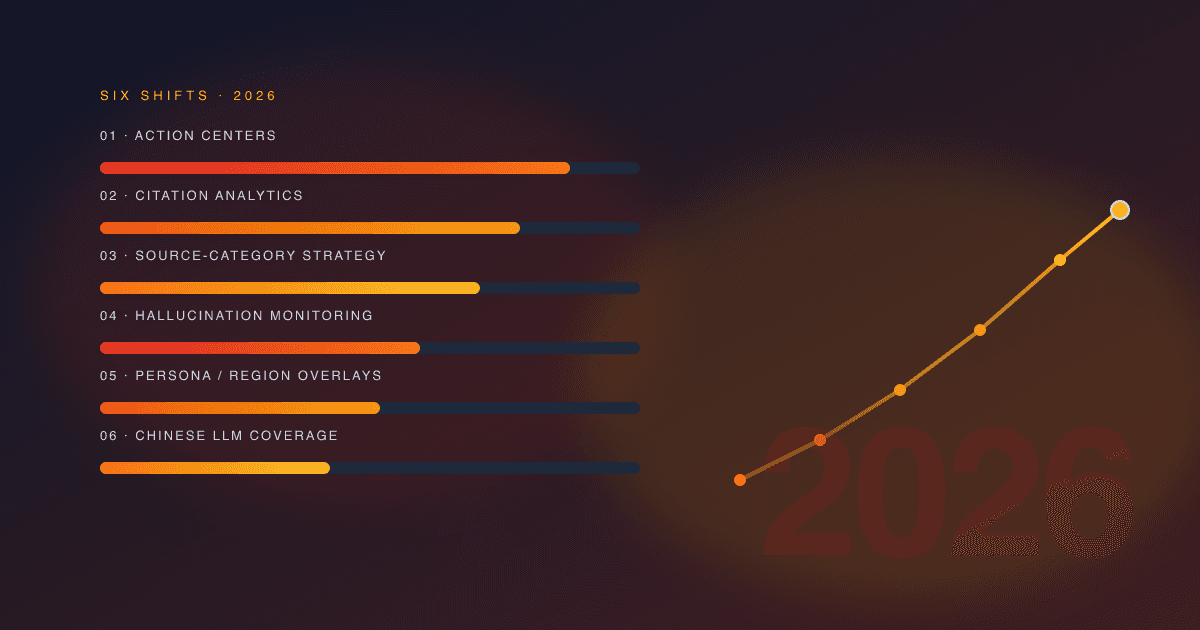
State of GEO 2026: Six Industry Shifts Shaping Brand AI Visibility
A year ago, "monitor my brand in ChatGPT" was a niche request. In 2026 it's a budget line. Here are the six shifts that defined the year for brands measuring AI visibility.
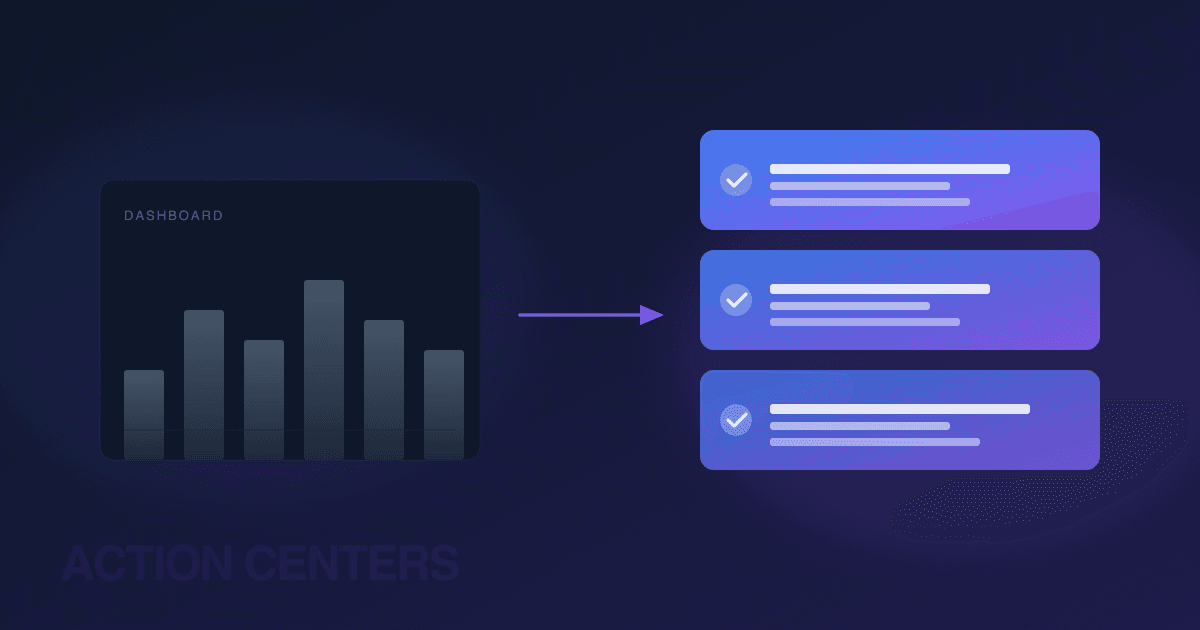
From Dashboards to Action Centers: Where GEO Tooling Is Heading in 2026
First-gen GEO tools showed you what was broken. The next generation tells you what to publish to fix it. Here's how the industry is collapsing the gap between visibility insight and content workflow.
Product Newsletter
Stay informed
Receive release notes, and workflow tips from SeenForAI.