Being Seen in the AI Era
Why we built SeenForAI — and what it means to be truly visible when AI becomes the primary discovery layer for brands.
Somewhere in the last two years, a quiet shift happened. People stopped asking Google "what's the best tool for X" and started asking ChatGPT. They stopped reading review roundups and started getting synthesized recommendations. The search bar didn't disappear — but a new kind of discovery appeared alongside it.
For brands, this shift created a problem with no good solution: you could be doing everything right and still be invisible, misrepresented, or wrong in the answer layer that millions of people were now using to make purchase decisions.
That's why we built SeenForAI.
The Visibility Gap
Brands have always cared about being found. They spend significant effort on SEO to rank in search results. They invest in social media to be seen by followers. They buy ads to appear in the right contexts. The infrastructure for measuring all of this — Google Search Console, analytics platforms, ad dashboards — has existed for years.
But for LLM visibility? Nothing.
When ChatGPT is asked "what's the best CRM for a small sales team," there's no tool that tells you whether your brand appeared in that answer, how it was described, or whether what was said was accurate. The answer is generated, synthesized, and delivered — and the brand it mentions or excludes has no idea it happened.
This isn't a minor gap. LLMs are now being asked product and brand research questions hundreds of millions of times per day. Each of those answers is a recommendation layer that sits above the web. And most brands are flying completely blind through it.
What "Seen For" Actually Means
The name SeenForAI carries a specific meaning that we think about carefully.
"Seen" isn't just about being mentioned. A brand can be mentioned in a negative context, described inaccurately, or referenced in a way that actively undermines buyer confidence. Being seen poorly is often worse than not being seen at all.
"For" means something specific: to be seen for what you actually are. For your real capabilities, your actual pricing, your genuine positioning. Not a hallucinated version. Not a competitor's framing. Not an outdated description from three years ago.
The goal isn't visibility for its own sake. It's accurate, favorable representation in the answers that shape how buyers understand your category.
The Hallucination Problem No One Talks About
Of all the problems with LLM brand representation, hallucination is the one that concerns us most — because it's the most invisible.
LLMs confidently state wrong things. A model might tell a user your tool doesn't support a feature you've had for two years. It might quote a pricing tier you retired last quarter. It might describe your company as a startup when you've been profitable for three years.
Users have no reason to doubt these claims. The answer is delivered with the same confidence as accurate information. The user makes a decision based on wrong data, and you never see a complaint, a refund request, or a lost deal trace back to the LLM answer that caused it.
The only way to find these problems is to systematically monitor what models say about your brand — at scale, across multiple LLMs, on a daily basis.
Why Seven LLMs
We track seven: ChatGPT, Claude, Gemini, Perplexity, Doubao, Kimi, and DeepSeek.
The Western four are obvious — they're the platforms your English-speaking users are most likely using for research. Perplexity in particular has emerged as a strong signal for purchase-intent queries; its citation-first design makes it a research tool as much as a conversational assistant.
The Chinese three are less obvious to most Western teams — and that's exactly why we include them. Doubao, Kimi, and DeepSeek collectively serve hundreds of millions of Chinese-speaking users, including large diaspora communities in North America, Australia, and Southeast Asia. A SaaS company with any international traction has Chinese-speaking users making decisions based on what these models say. Most of those companies have never checked.
Coverage isn't just about quantity. It's about the fact that different LLMs have meaningfully different training data, different retrieval behavior, and different tendencies for both accuracy and sentiment. Your brand might be described well on ChatGPT and inaccurately on Kimi. You need to know.
What We Built
SeenForAI runs your customized prompt set daily across all seven platforms. You provide your brand name, domain, competitors, and industry. We generate prompts that mirror what your target buyers actually ask — awareness questions, comparison questions, decision-stage questions.
Every day, the platform collects answers, extracts brand mentions, assesses sentiment, flags hallucinations via cross-model verification, and tracks which URLs are being cited. The result is a dashboard that tells you:
- Your Share of Voice per LLM and in aggregate — what percentage of relevant answers include your brand
- Your sentiment breakdown — how each model frames you
- Hallucination alerts — when a model states something factually wrong, verified against your product information
- Citation tracking — which external sources are shaping how models describe you
The goal is to give brands the same clarity about their LLM presence that Google Search Console gives them about their search presence. Not a one-time snapshot, but an ongoing view that tracks movement over time.
The Standard We're Working Toward
A few years from now, "what does ChatGPT say about us?" should be as routine a question as "where do we rank on Google?" Every brand team should have a dashboard for it. Every product launch should include a check of LLM representation. Every PR campaign should have a metric for LLM impact.
We're not there yet. But the brands that start measuring now will have months of baseline data when the rest of the market catches up — and that baseline is what makes the optimization meaningful.
If you haven't checked what LLMs say about your brand, the free scan at seenfor.ai takes under a minute. You'll see your Share of Voice across four LLMs and whether any of them are saying something about your brand that isn't true.
Most teams are surprised. That surprise is the beginning of the work.
Further reading
More Posts
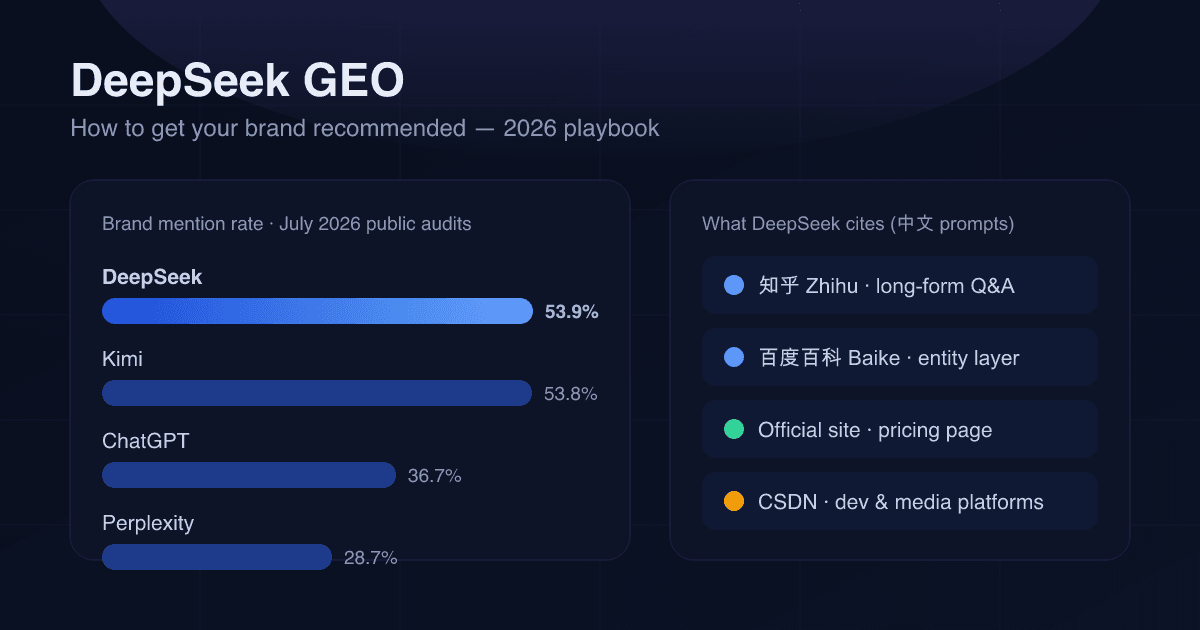
DeepSeek GEO: How to Get Your Brand Recommended (2026)
DeepSeek answers millions of product questions daily. Here's how it picks brands to recommend — and a step-by-step playbook to become one of them.

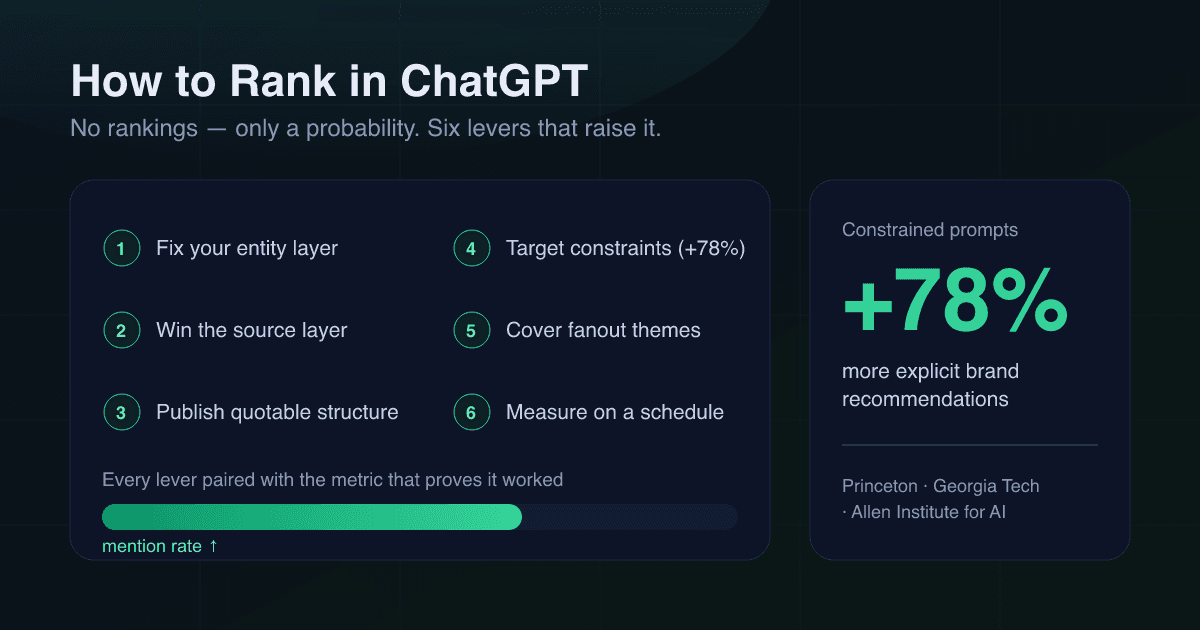
How to Rank in ChatGPT: A Measurable 6-Step Playbook (2026)
ChatGPT has no rankings — only a probability your brand gets named. Six levers that raise it, with data on what actually moves the needle.
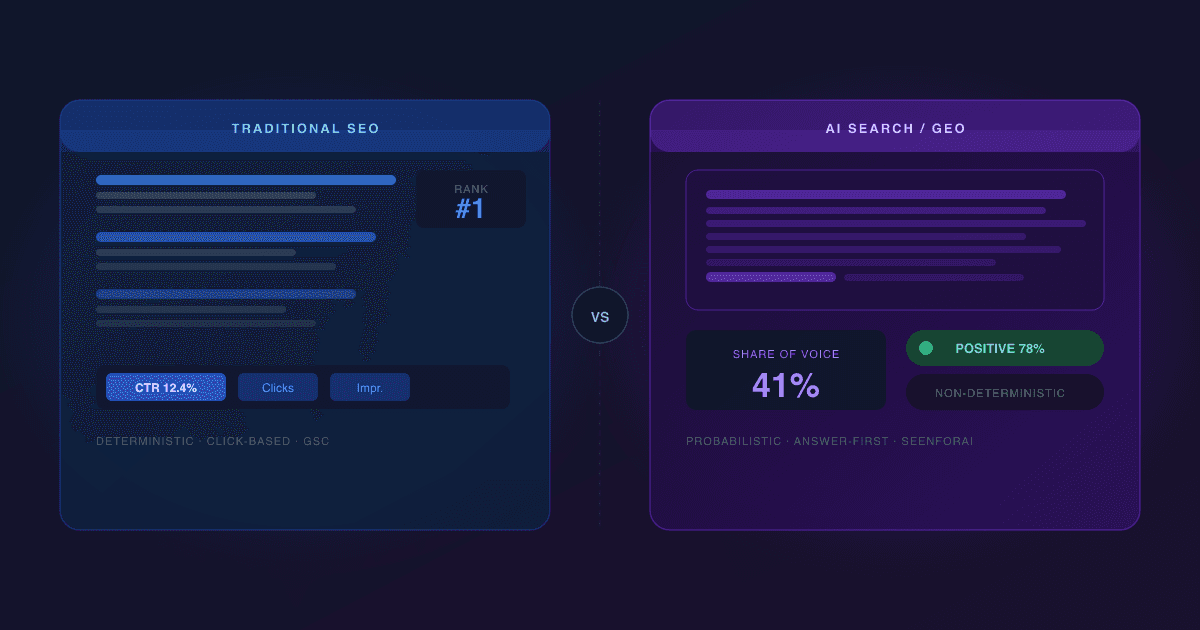
AI Search vs Traditional SEO: What's the Difference?
Rankings and LLM mentions are two separate games. Here's how they differ — and why marketers need to play both.
Product Newsletter
Stay informed
Receive release notes, and workflow tips from SeenForAI.