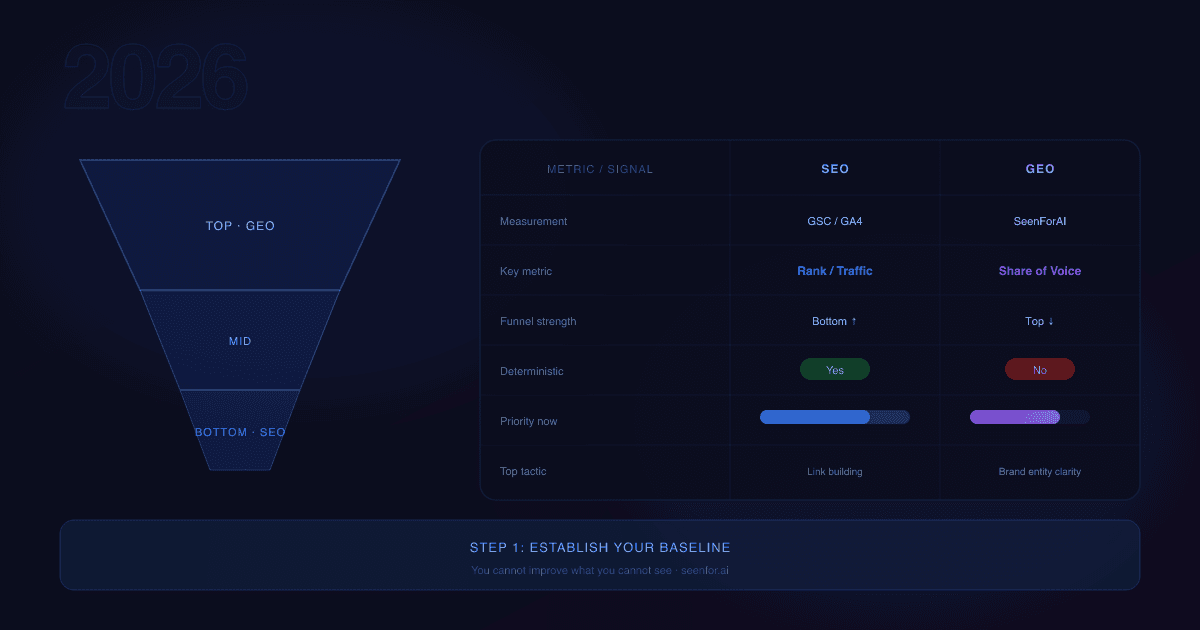
GEO vs SEO: What You Actually Need in 2026
Both still matter, but the investment priorities have shifted. Here's a practical playbook for brand visibility across search and LLMs.
The debate is framed badly. "Is GEO replacing SEO?" is the wrong question, and the people asking it are usually trying to sell you something. The accurate version is quieter and more useful: LLM-driven discovery is becoming a meaningful share of top-funnel awareness, and most teams aren't measuring it yet.
Here's what the two disciplines actually require in 2026, and where to put your time first.
What SEO Still Does Well
Traditional search optimization isn't going anywhere — it's just not the only game anymore.
SEO remains the strongest channel for:
- Bottom-of-funnel transactional queries: "buy X", "X pricing", "X vs Y comparison", "X review 2026". When a user is ready to make a purchase decision and types a specific query, Google's intent matching is still more precise than any LLM answer.
- Product-specific long-tail keywords: Your feature pages, integration docs, and use-case landing pages drive qualified traffic that's close to converting. LLMs rarely surface these; search does.
- Attribution: GSC gives you impressions, clicks, and position data. You know what's working. LLM visibility doesn't have an equivalent native measurement layer — you need a dedicated tool for that.
If you have an established SEO program generating measurable pipeline, don't disrupt it. Extend it.
What GEO Requires
GEO — optimizing for LLM brand presence — runs on different inputs than SEO. The four levers that actually move your Share of Voice:
1. Brand entity clarity
LLMs form an opinion about your brand from the aggregate of what's written about you across the web. If your brand name appears in contexts that are inconsistent — different descriptions on your own site, your Crunchbase profile, G2 listing, and press coverage — the model's understanding is diluted.
Audit the key factual claims about your brand in public sources: what you do, who you serve, what category you compete in, your pricing tier. Make them consistent and clear. This sounds mundane, but it's the foundation.
2. Authoritative third-party coverage
Your own content counts for less than you'd hope. LLMs weight independent, authoritative sources heavily. A mention in a respected industry publication, an analyst comparison report, or a well-read community post carries more GEO weight than a dozen posts on your own blog.
Target coverage in the publications, newsletters, and communities that your target audience reads — and that LLMs have clearly learned from. Product Hunt launch coverage, IndieHackers discussions, G2 category listings, and vertical-specific media are all strong signals.
3. Structured FAQ and comparison content
LLMs extract from content that's clearly structured. An FAQ section that directly answers "What does [Brand] do?" and "How does [Brand] compare to [Competitor]?" gives the model clean, quotable passages.
Vague positioning copy ("we help teams work better") doesn't extract well. Specific, factual descriptions ("we monitor your brand's Share of Voice across seven LLMs, updated daily") do.
4. Consistent independent brand mentions
Frequency across independent sources matters. A brand mentioned across 40 different sites is more visible to an LLM than a brand mentioned 40 times on its own domain. The diversity and independence of sources signals credibility.
This means community participation, guest posts, podcast appearances, and press coverage all have GEO value — not just SEO value.
Measure Before You Optimize
The biggest mistake teams make is trying to run GEO tactics before establishing a baseline. You might invest three months in a PR campaign, new FAQ content, and community activity — and have no idea whether it moved your LLM Share of Voice because you never measured your starting point.
The rule is simple: establish your baseline first. Run a snapshot of your brand's LLM presence — what's your SoV on ChatGPT, Gemini, Perplexity? What's the sentiment? What's being hallucinated? — before you do anything else. Then run it again after each major activity and look for movement.
Without a baseline, GEO is just guesswork with extra steps.
The 2026 Measurement Stack
These tools are complementary, not competing:
| Tool | What it measures |
|---|---|
| Google Search Console | Organic search impressions, clicks, position |
| Google Analytics / GA4 | On-site behavior, conversions, traffic sources |
| SeenForAI | LLM Share of Voice, sentiment, hallucinations, citations across 7 platforms |
GSC covers your search presence. SeenForAI covers your LLM presence. You need both to have a complete picture of how your brand is being found.
Detecting Whether GEO Work Is Moving the Needle
Once you have a baseline, track these signals weekly:
- SoV trend by LLM: Is your overall mention rate going up? Are specific platforms lagging?
- Sentiment shifts: After a PR campaign or a product launch, does sentiment improve on any platform within 2–4 weeks?
- Citation changes: Are new URLs appearing in LLM citations? If your new comparison page starts getting cited, that's a clear signal it's working.
- Hallucination resolution: After you publish corrective content or update your public listings, do the specific hallucinations disappear?
Changes in LLM behavior happen on a lag — models update, retrieval indexes refresh, new content propagates. Don't expect instant results, but within a month of meaningful activity you should see signal.
The practical first step hasn't changed in two years: measure where you stand before you try to improve it. Get a free brand scan at seenfor.ai — it takes under a minute and gives you your current SoV across four LLMs, which is the baseline every GEO effort should start from.
Further reading
More Posts
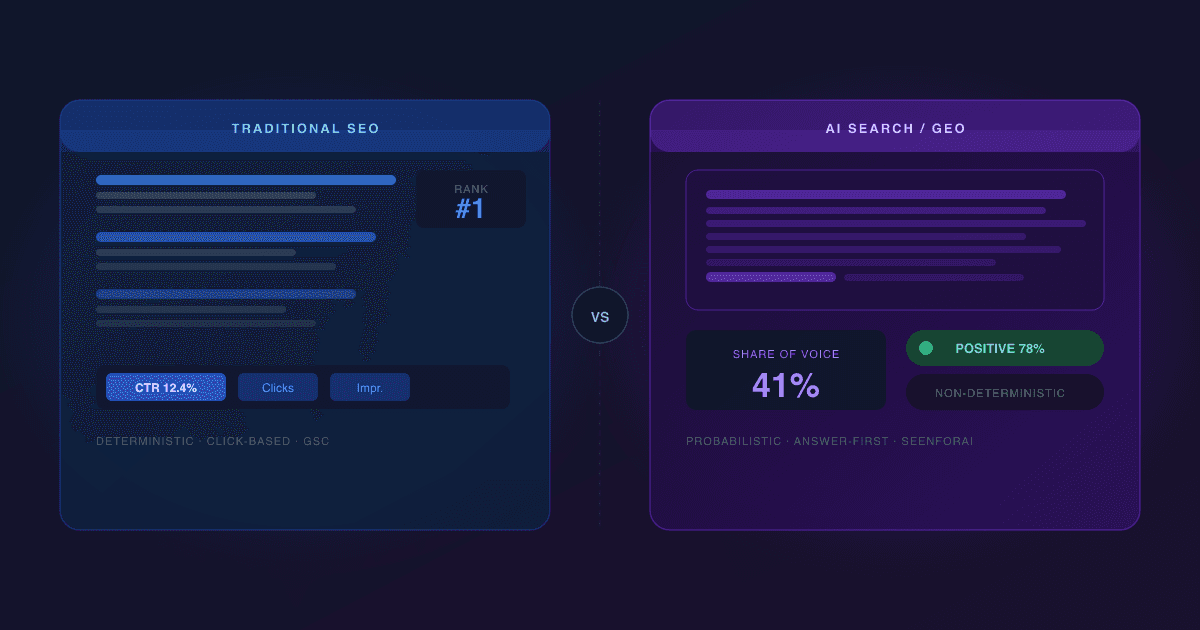
AI Search vs Traditional SEO: What's the Difference?
Rankings and LLM mentions are two separate games. Here's how they differ — and why marketers need to play both.

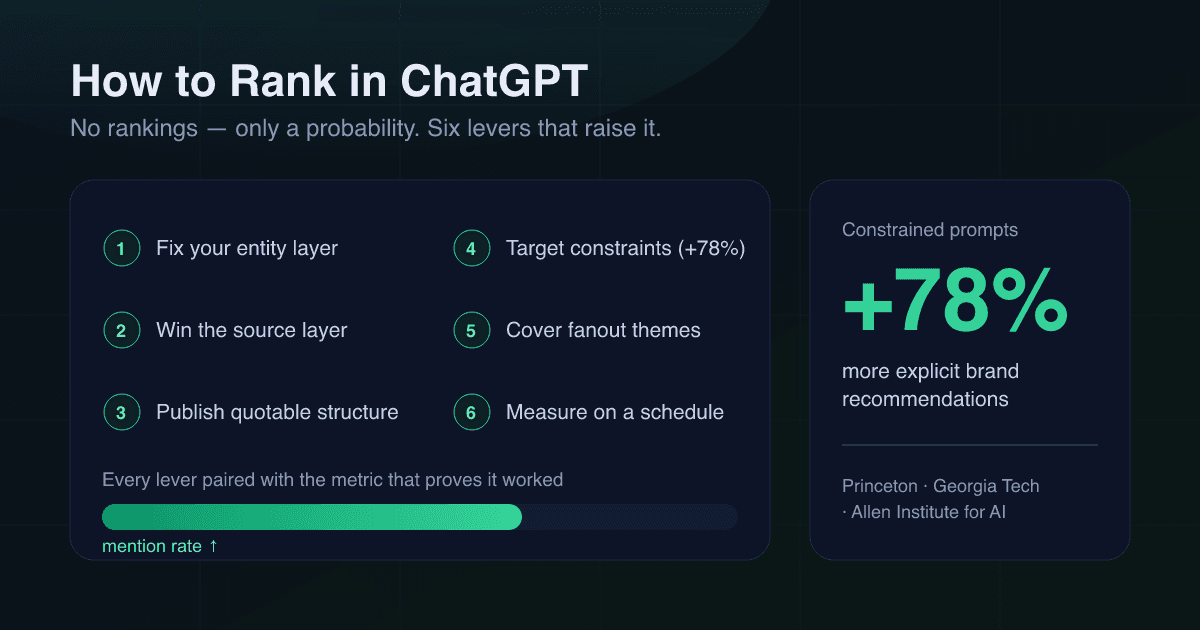
How to Rank in ChatGPT: A Measurable 6-Step Playbook (2026)
ChatGPT has no rankings — only a probability your brand gets named. Six levers that raise it, with data on what actually moves the needle.
Being Seen in the AI Era
Why we built SeenForAI — and what it means to be truly visible when AI becomes the primary discovery layer for brands.
Product Newsletter
Stay informed
Receive release notes, and workflow tips from SeenForAI.