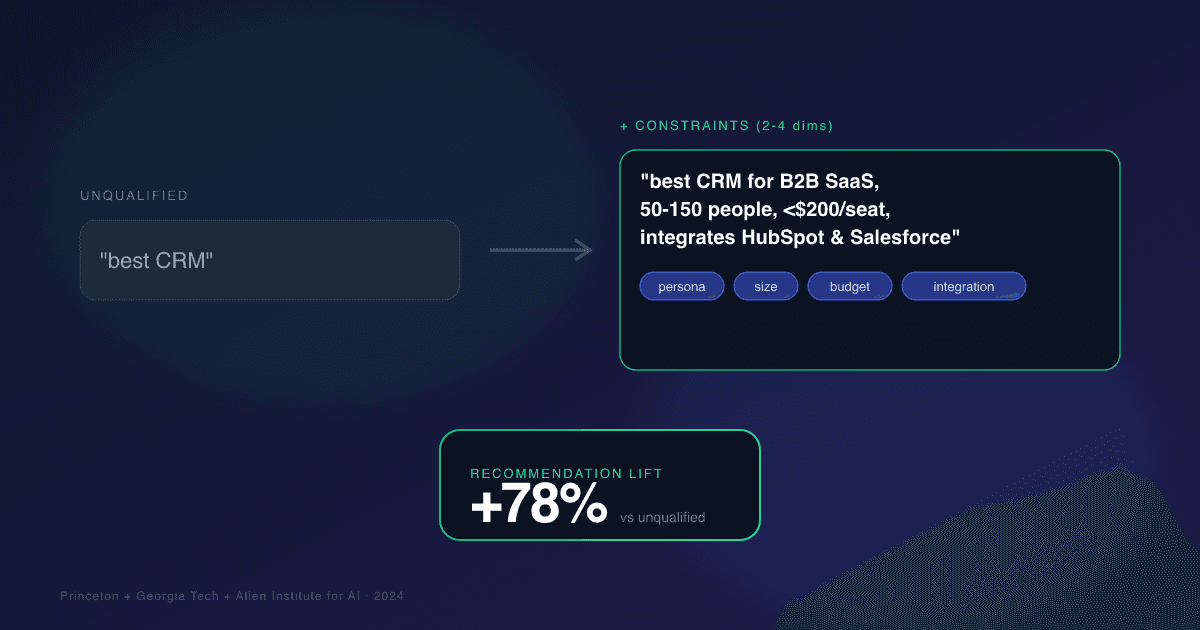
Constraint Injection: The Princeton Trick That Lifts AI Brand Recommendations 78%
A 2024 study from Princeton, Georgia Tech, and the Allen Institute for AI shows that adding 2-4 constraints to a prompt makes LLMs surface specific brand recommendations 78% more often. Here's how to use it.
Most teams testing AI visibility ask the LLM something like "best CRM" and treat the result as the measurement. Then they're surprised when the answer is generic — "Salesforce, HubSpot, and Zoho are all popular" — and their own brand never appears.
The fix isn't more prompts. It's more constraints inside each prompt.
The 78% finding
A 2024 study from researchers at Princeton, Georgia Tech, and the Allen Institute for AI tested how often LLMs surface specific brand recommendations as a function of prompt qualifiers. The headline result: prompts containing 2-4 constraint dimensions triggered explicit brand recommendations 78% more often than the same query without constraints.
The mechanism is intuitive. With no constraints, the LLM has no reason to narrow — so it falls back to the safest answer, which is to list the three most famous incumbents. The moment you add constraints, the model has to do real work: filter to the subset that fits "B2B SaaS, 50-150 people, $200/seat budget, integrates with HubSpot." Smaller and challenger brands suddenly become the correct answer.
If you only measure unqualified prompts, you're systematically undercounting how often AI is actually willing to recommend you.
Bad prompt vs good prompt
The same intent, written two ways:
Unqualified (avoid):
Best CRMConstrained (use):
Best CRM for B2B SaaS companies with 50-150 employees,
budget under $200/seat/month, that integrates with
HubSpot and Salesforce.
The first is a keyword. The second is the way a real buyer thinks. The first measures whether you're already a household name. The second measures whether your positioning actually wins when a buyer narrows down — which is the only thing GEO can reliably influence.
The seven dimensions worth injecting
There's no single "right" set of constraints. The dimensions that move the needle in practice:
- Persona — indie hacker, SMB owner, enterprise IT, marketing agency. Highest signal of the seven; SeenForAI always picks this one.
- Team size — fewer than 10, 10-50, 50-150, more than 150. Dramatically changes which tier of vendor the LLM cites.
- Budget — free tier, under $50, under $200/seat, enterprise. Filters out vendors that simply don't fit.
- Industry — B2B SaaS, ecommerce, fintech, healthcare. Triggers vertical-specific shortlists.
- Geo — US, EU, APAC, China, UK. Same prompt returns different brands in different markets.
- Integration — Slack, GitHub, HubSpot, public API, Zapier. Strong filter when ecosystem fit matters.
- Output format — "list top 5 with pros and cons", "as a comparison table", "based on reputable sources". Influences how the LLM answers, not just what it answers.
The research caveat is "qualifier density". One constraint barely moves the result. Five or six over-narrow it — the LLM gives up and returns nothing useful. The sweet spot is 2 to 4 dimensions per prompt, varied across the set so density stays balanced.
Why this matters more for challengers than incumbents
Salesforce shows up in the unqualified "best CRM" answer because it shows up everywhere. They don't need constraints to be visible. The brands that benefit most from constraint injection are the ones whose competitive positioning is the constraint — the SMB-friendly alternative, the developer-first option, the EU-compliant build. If your differentiation is real, constrained prompts will surface it. If it isn't, you'll find out quickly.
SeenForAI's prompt generator now injects 2-4 constraint dimensions into every prompt by default, varies them across the batch, and tags each row with the dimensions used so you can analyse Share of Voice by constraint. If your existing prompt set is mostly unqualified keywords, regenerating once is the single highest-leverage thing you can do this quarter.
Further reading
More Posts
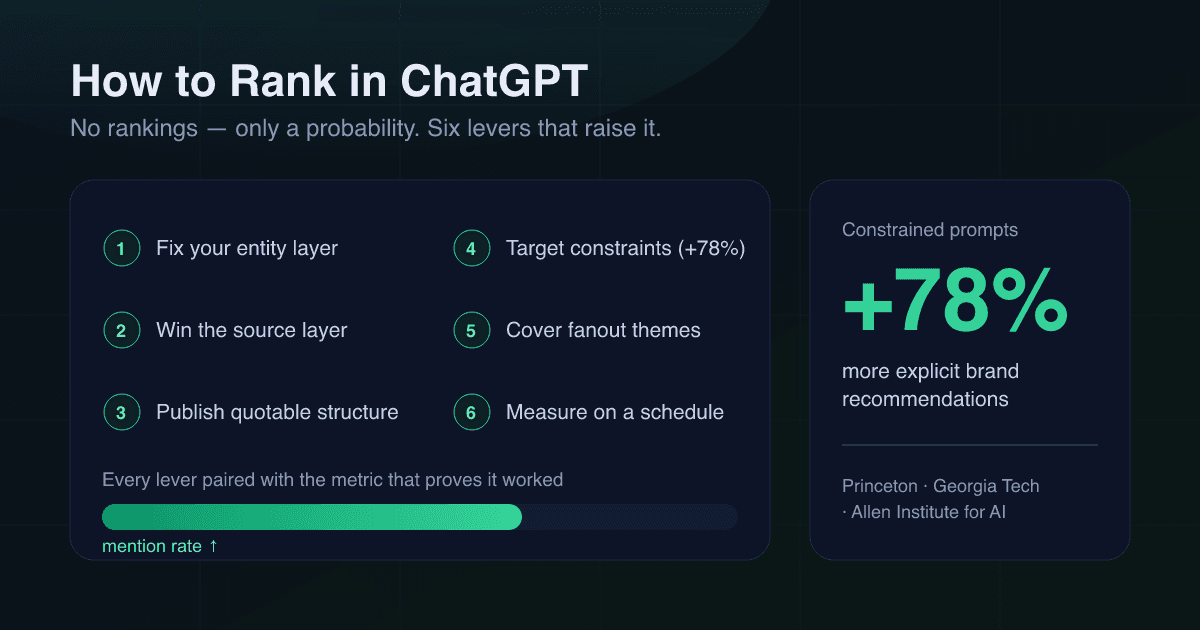
How to Rank in ChatGPT: A Measurable 6-Step Playbook (2026)
ChatGPT has no rankings — only a probability your brand gets named. Six levers that raise it, with data on what actually moves the needle.

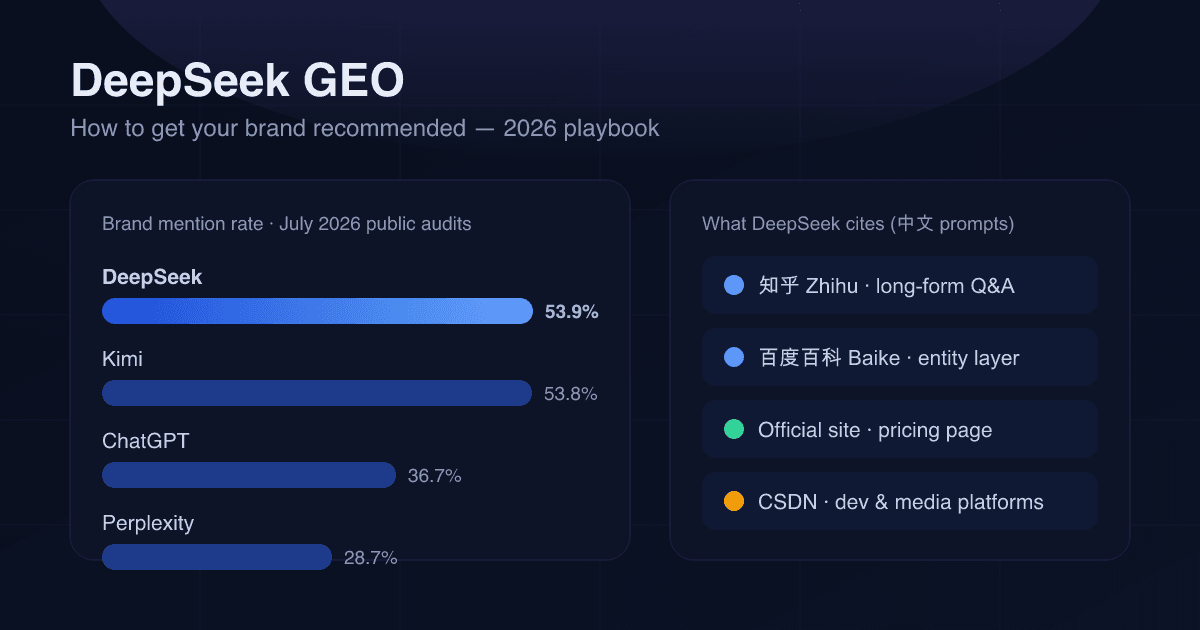
DeepSeek GEO: How to Get Your Brand Recommended (2026)
DeepSeek answers millions of product questions daily. Here's how it picks brands to recommend — and a step-by-step playbook to become one of them.
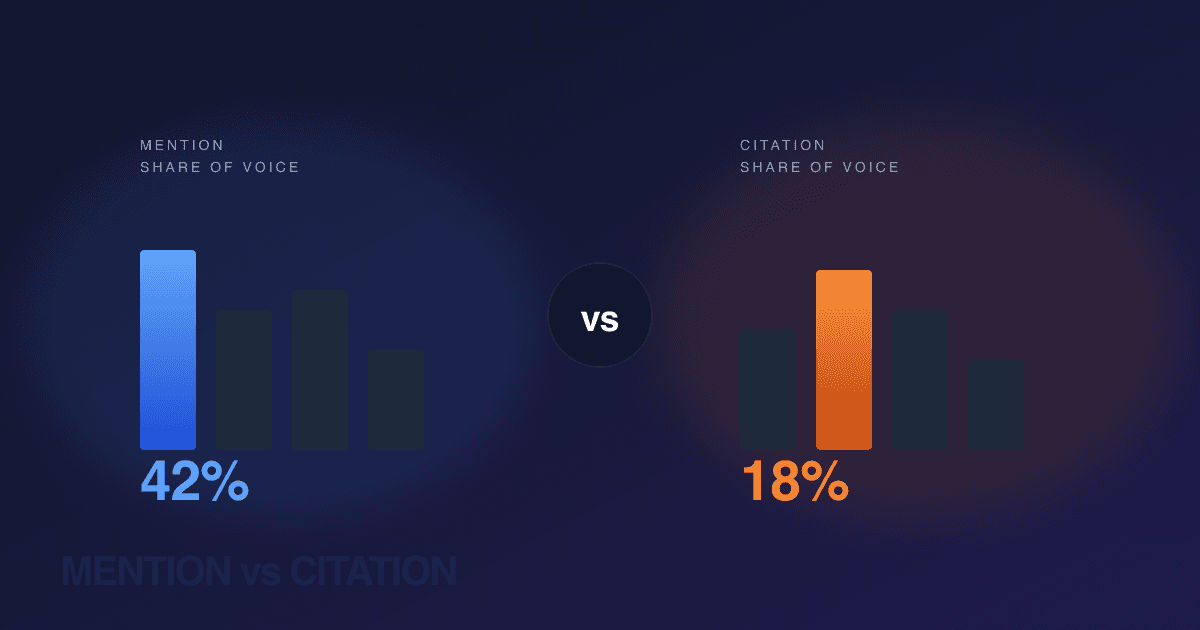
Mention vs Citation: The Share of Voice Split Most GEO Dashboards Get Wrong
ChatGPT mentions your brand in prose but cites your competitor's docs underneath. Which signal counts? Both — but they tell you completely different things, and most dashboards only show one.
Product Newsletter
Stay informed
Receive release notes, and workflow tips from SeenForAI.