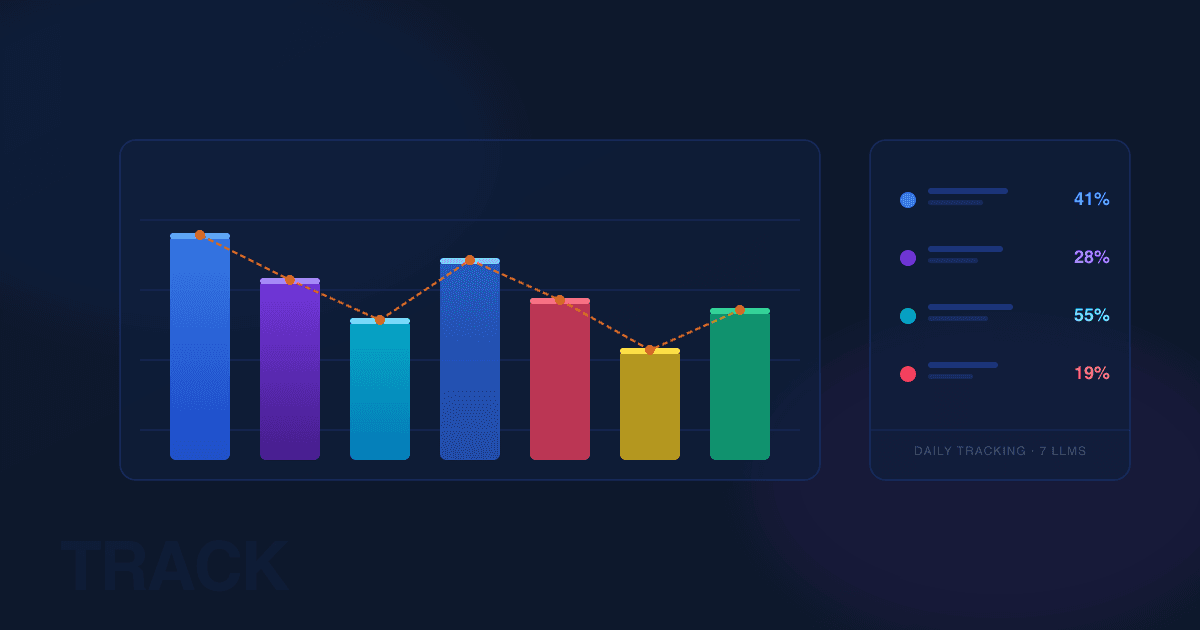
How to Track Your Brand Mentions in ChatGPT
GA4 won't show you LLM referrals. Here are three approaches to tracking your brand in ChatGPT — and when each one makes sense.
Open Google Analytics right now and look for your ChatGPT referral traffic. You won't find it — or you'll see a tiny sliver under "direct" with no query data attached. That's not a tracking bug. It's a structural gap: when a user gets an answer from ChatGPT and then visits your site, there's no UTM, no referrer header, and no breadcrumb back to the LLM conversation.
But the harder problem isn't measuring traffic from ChatGPT. It's measuring presence in ChatGPT — whether your brand appears in answers at all, how often, and in what context.
Here are the three approaches teams use, with honest trade-offs for each.
Approach 1: Manual Prompting
The most accessible approach is also the most obvious: open ChatGPT and start asking questions your target customers might ask.
A practical prompt structure:
- Awareness: "What tools do [role] use to [job to be done]?" → e.g., "What tools do marketing managers use to monitor brand reputation?"
- Consideration: "Compare [Your Brand] and [Competitor] for [use case]"
- Decision: "What's the best tool for [specific outcome] in [year]?"
Run each prompt 3–5 times. LLMs are non-deterministic — the same question asked twice can produce different answers. A single response tells you almost nothing. Multiple runs start to reveal a pattern.
When it works: One-time audits. If you want a quick gut-check on whether ChatGPT knows your brand exists, manual prompting takes 20 minutes.
Where it breaks down: At scale, manual prompting is not a monitoring strategy. You'd need to run hundreds of prompts across multiple LLMs every day to spot trends. You also can't easily track sentiment — "your brand is a solid choice" and "your brand has mixed reviews" are both mentions, but they're very different signals.
Approach 2: Scripts via API
If you have technical resources, you can build a lightweight brand monitor using the OpenAI API (for ChatGPT), Anthropic API (Claude), and Google Gemini API.
The basic loop:
- Define a prompt set (20–100 prompts covering your category)
- Call each model's API, store the raw completions
- Run string matching or a secondary LLM pass to detect brand mentions
- Write results to a spreadsheet or database
This works and gives you full control. The problems:
- Non-determinism requires sampling. You need to run each prompt multiple times per model to get a stable mention rate. A single run is noise.
- Prompt maintenance. Your category evolves. New competitors emerge. Prompts get stale. Someone has to own this.
- Seven LLMs, not one. ChatGPT is the most visible, but Perplexity drives real purchase research traffic, and Doubao/Kimi are the dominant discovery layer for Chinese-speaking users. Building coverage across all of them multiplies the engineering surface area.
- Sentiment and context parsing. Detecting whether your brand was mentioned is step one. Understanding how it was described requires parsing unstructured text — which means more code to maintain.
When it works: Teams with a developer who wants granular control and is willing to maintain the pipeline.
Where it breaks down: Most marketing teams can't own a seven-API data pipeline. It becomes infrastructure, not insight.
Approach 3: Dedicated LLM Brand Monitoring
The third approach is using a tool built specifically for this problem. This is what SeenForAI does.
You provide your brand name, domain, competitors, and industry. SeenForAI generates a curated prompt set — awareness, consideration, and decision-stage questions — and runs them daily across ChatGPT, Claude, Gemini, Perplexity, Doubao, Kimi, and DeepSeek. Results are aggregated into a dashboard showing:
- Share of Voice: what percentage of relevant prompts include your brand
- Sentiment breakdown: how each LLM describes your brand
- Competitor comparison: how your SoV stacks up against named competitors
- Citation tracking: which URLs the LLMs are citing when they mention you
- Hallucination alerts: when a model states something factually incorrect about your brand
The daily cadence matters because LLM behavior changes. Model updates, new competitor content, and shifts in training data can all move your Share of Voice — sometimes significantly — over weeks. Monitoring once and forgetting is as useful as checking your Google rankings once in 2019.
Choosing the Right Approach
| Manual | Scripts | SeenForAI | |
|---|---|---|---|
| Setup time | Minutes | Days–weeks | Minutes |
| LLM coverage | 1 at a time | You build it | 7 out of the box |
| Daily monitoring | No | Possible | Yes |
| Sentiment analysis | Manual read | Custom code | Built in |
| Non-technical team | Yes | No | Yes |
For a one-time audit, start manual. For engineering teams that want raw data ownership, scripts are viable. For teams that need ongoing visibility without maintaining infrastructure, a dedicated tool removes the friction.
Whatever approach you choose, the act of measuring is what matters most. Most brands have no idea what ChatGPT says about them today — which means they also have no baseline to improve from. That's the gap worth closing first.
Get a free brand scan to see your current Share of Voice across four LLMs in under a minute.
Further reading
More Posts
Being Seen in the AI Era
Why we built SeenForAI — and what it means to be truly visible when AI becomes the primary discovery layer for brands.

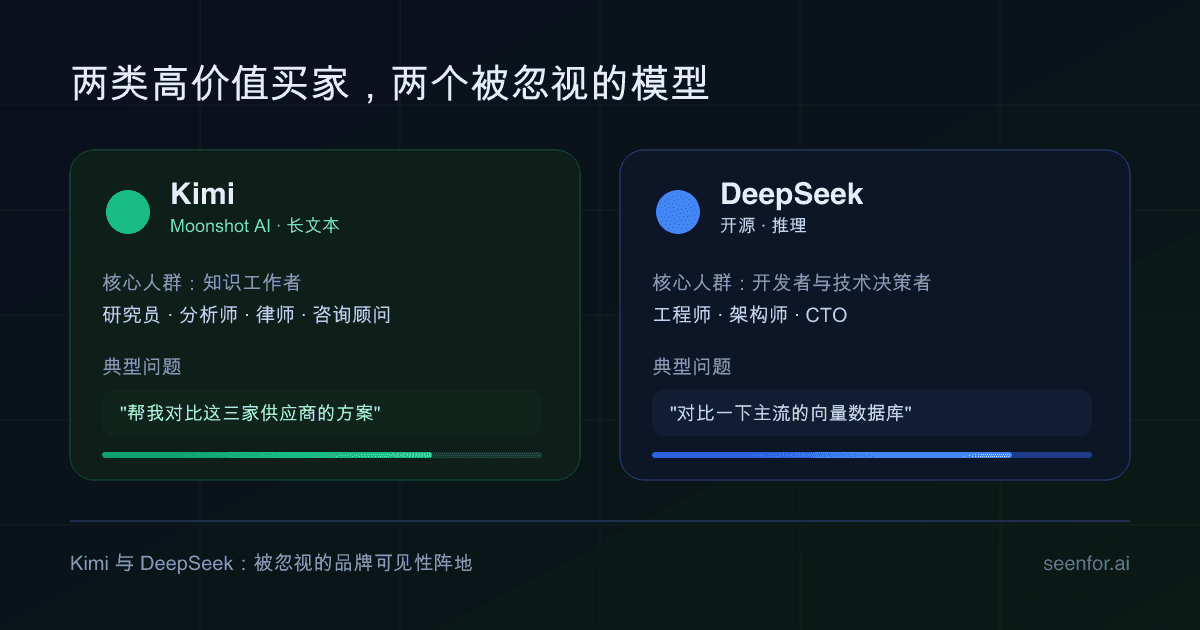
Kimi and DeepSeek: The Brand Visibility Channels Nobody Watches
Kimi owns knowledge workers; DeepSeek owns developers and technical decision-makers. Two high-value audiences are making buying decisions through them — and almost no brand is measuring it.
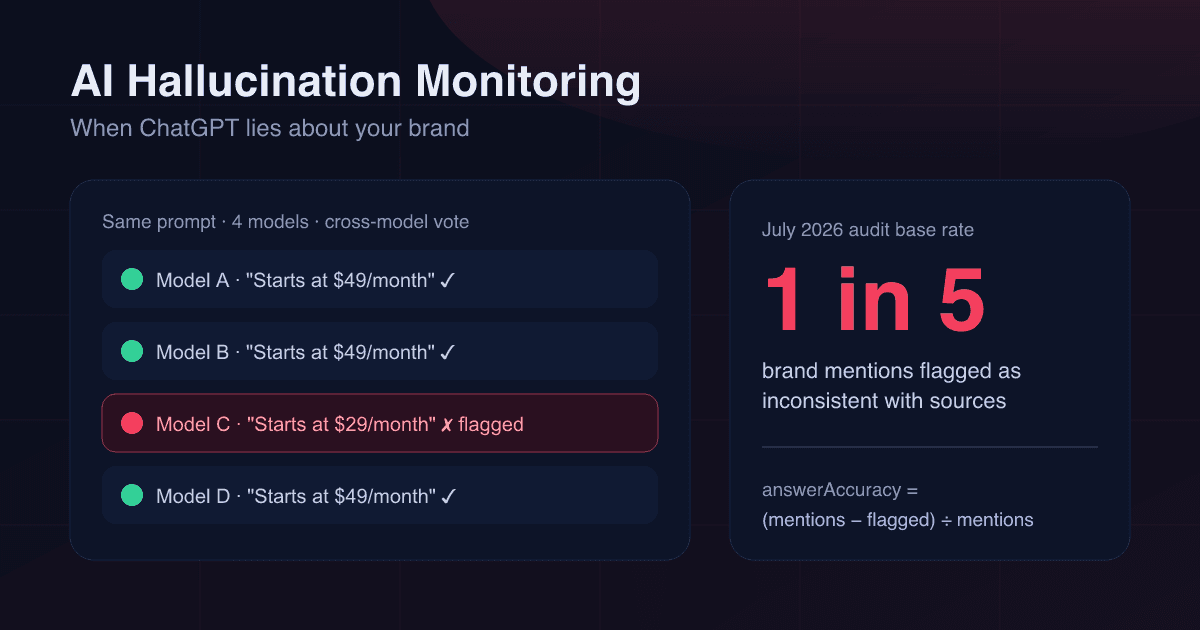
AI Hallucination Monitoring: When ChatGPT Lies About Your Brand
LLMs confidently invent pricing, features and even founders. How to detect brand hallucinations — and the multi-model voting method that verifies them.
Product Newsletter
Stay informed
Receive release notes, and workflow tips from SeenForAI.