DeepSeek GEO: How to Get Your Brand Recommended (2026)
DeepSeek answers millions of product questions daily. Here's how it picks brands to recommend — and a step-by-step playbook to become one of them.
DeepSeek GEO — getting your brand into DeepSeek's recommendations — is the least crowded opportunity in AI search right now. DeepSeek answers millions of product and brand questions a day for a global user base that exploded after R1's January 2025 release, yet almost nobody is deliberately optimizing for it: Western GEO playbooks stop at ChatGPT and Perplexity, and Western tools mostly treat DeepSeek as a checkbox engine. The mechanics are learnable: DeepSeek picks brands the same two-layer way other assistants do — parametric memory plus web retrieval — but with a source pool that skews heavily Chinese for Chinese-language queries. This guide covers how it works, what it cites, and a checklist to become one of its answers.
How DeepSeek answers brand and product questions
Like every modern assistant, DeepSeek builds a recommendation from two layers:
Parametric memory. What the model absorbed at training time. Ask "best CRM for startups" with web search off and you get the consensus of DeepSeek's training corpus — which, unusually among frontier models, is strong in both English and Chinese web data. Brands with deep Chinese-language coverage surface here even when their English footprint is thin, and vice versa.
Retrieval. DeepSeek's chat apps ship a web-search mode that fetches live pages and grounds the answer in them. When it's on, the recommendation is only as good — and as current — as the pages retrieved. This is the layer you can move in weeks rather than quarters.
Two practical differences from ChatGPT are worth knowing. First, the reasoning models (R1 and successors) show their chain of thought — you can literally watch the model weigh "the user needs X, candidates are A/B/C" and see which constraint knocked your brand out. Run your own category prompt and read the reasoning; it's free competitive intelligence no other major assistant gives you. Second, DeepSeek's answers to Chinese-language prompts draw from a substantially different source pool than its English answers — which is the next section.
What sources DeepSeek actually cites
The pattern we see across scans: the language of the prompt decides the source pool. English prompts pull from the familiar Western pool — review sites, docs, Reddit, comparison posts. Chinese prompts pull mostly from the Chinese-language web:
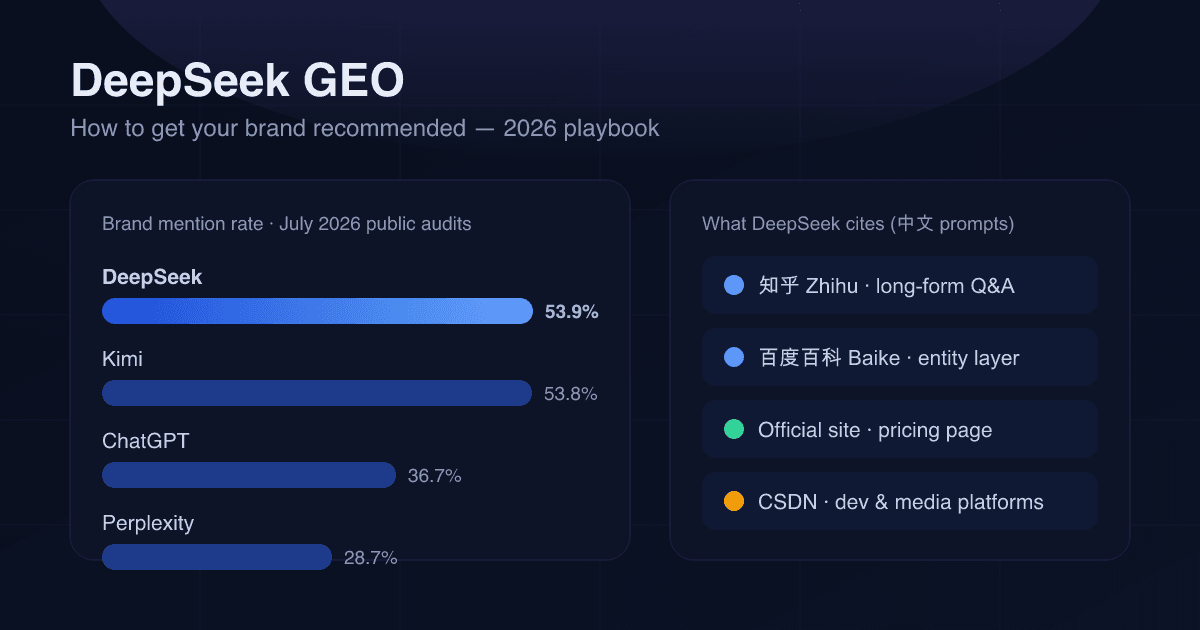
- Zhihu (知乎) — the closest analogue to Reddit's role in Western AI answers: long-form Q&A with named alternatives and reasons. Recommendation-style Zhihu answers are prime citation material.
- Baidu Baike (百度百科) — the entity layer. Like Wikipedia for Western models, an accurate Baike entry anchors who you are, what you make, and your founding facts.
- Official brand sites — DeepSeek cites brand domains readily when a crawlable Chinese (or at least English) pricing/features page exists.
- Developer and media platforms — CSDN, juejin and tech media for technical categories; industry verticals elsewhere.
The strategic implication: if your brand has no Chinese-language footprint at all, you are invisible to the Chinese-prompt half of DeepSeek's traffic no matter how strong your English SEO is. We see this constantly in audit data — brands with solid Western visibility flatline on Chinese-language runs.
The DeepSeek visibility checklist
Work through these in order; the early items are the cheapest.
- Run the baseline. Ask DeepSeek (search on and off) your category's top 10 buyer questions in English and Chinese. Record: are you named, at what position, with what facts. This is your before-picture — our free checker runs a live prompt across DeepSeek, ChatGPT, Kimi and Doubao if you want the one-click version.
- Fix your entity. Accurate official site with a plain, crawlable pricing and features page; consistent naming everywhere; an English Wikipedia entry if you qualify, a correct Baidu Baike entry if you have any China presence.
- Build the Chinese-language layer. Even a minimal one: a translated product page, a Zhihu account answering category questions honestly, listings in Chinese software directories. This single step separates you from nearly every Western competitor.
- Publish comparison content. "X vs Y" and "best tools for [use case]" pages give retrieval a ready-made recommendation structure to quote — in both languages if you can.
- Read the reasoning chains. Run your prompts against the reasoning model and note why you lose: wrong facts, missing constraint fit, or absence from the candidate set. Each failure mode has a different fix (correct the sources / sharpen positioning content / build the entity layer).
- Monitor continuously. DeepSeek ships new model versions fast, and each one reshuffles parametric memory. A one-off check is a snapshot of an engine that just changed.
Measuring it: mention rate, position, sentiment
Anecdotes don't survive model updates; metrics do. The four numbers that matter, defined the way we compute them at SeenForAI:
- Mention rate — runs where DeepSeek names you ÷ completed runs. For calibration: in our July 2026 public audits, DeepSeek's mention rate for the audited brand was 53.9% (Framer) and 47.1% (Beehiiv) — ahead of Perplexity in both scans, and roughly in line with Kimi. DeepSeek is not a rounding error in your AI visibility; for some brands it's the friendliest major engine.
- Average position — where you appear in the list. Position 1–2 in a "best of" answer captures most of the persuasion value.
- Sentiment — how you're framed when named: recommended, neutral-listed, or caveated.
- Citation rate — how often your mention is backed by a source, and whose domain that source is. Mentions grounded in your pages are the durable kind.
The full metric definitions live in our GEO guide.
DeepSeek vs Doubao vs Kimi: same playbook?
About 80% the same, 20% meaningfully different. All three reward the same foundation: clean entity data, a real Chinese-language footprint, and quotable comparison content. The differences that matter:
- DeepSeek has the most global, developer-heavy audience of the three and answers plenty of English prompts. It's the one Chinese LLM where your English footprint still does real work — see our deep-dive on Kimi and DeepSeek brand visibility.
- Doubao lives inside ByteDance's ecosystem, skews consumer, and leans on its own content universe — the playbook is more China-native; we covered it in How to Get Doubao to Recommend Your Brand. Note that in both July audits Doubao's mention rate for the Western brand was 0% — the gap between DeepSeek-friendly and Doubao-visible is enormous.
- Kimi (Moonshot) is strongest on long-document and research-style queries, where being present in the documents users feed it (reports, comparisons, docs) matters as much as the open web.
Treat DeepSeek as the bridge engine: the place where a Western brand's existing assets go furthest, and the natural first target before investing in the fully China-native channels.
FAQ
Does DeepSeek recommend brands and products? Yes — short named lists with reasons, millions of times a day. In our July 2026 audits it named the audited brand in roughly half of runs, ahead of Perplexity both times.
How is DeepSeek GEO different from ChatGPT GEO? Same two-layer mechanics, different source pool: Chinese-language prompts lean on Zhihu, Baidu Baike, CSDN and official sites. No Chinese footprint means no visibility on that half of the traffic.
How do I track my brand's visibility in DeepSeek? Fixed buyer-style prompt set, run on a schedule, tracking mention rate, position, sentiment and citations. SeenForAI includes DeepSeek on every plan, free included.
Do Doubao, Kimi and DeepSeek need different playbooks? ~80% shared foundation (entity data, Chinese-language layer, comparison content), 20% engine-specific. Measure separately before optimizing.
How long does DeepSeek GEO take? Retrieval fixes: weeks. Parametric memory: the next model version — think quarters.
Claim the empty ground
Every brand in your category is fighting for the same ChatGPT answer. Almost none of them have looked at DeepSeek. Run a free AI visibility check — it queries DeepSeek live alongside ChatGPT, Kimi and Doubao — and see where you stand before your competitors think to ask.
Further reading
More Posts
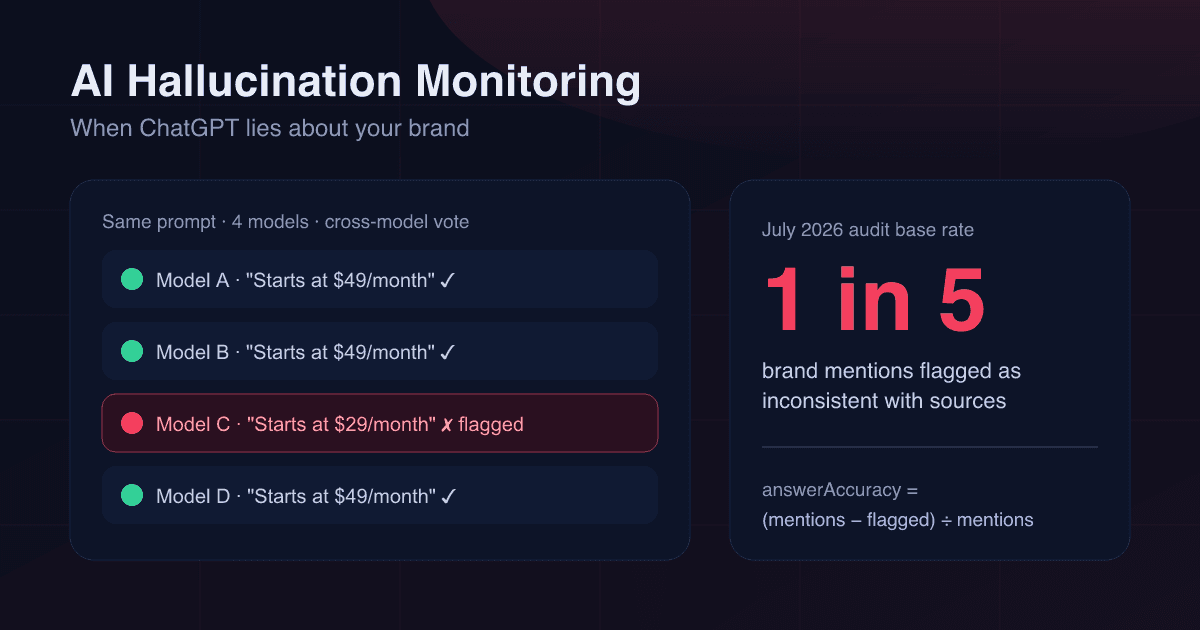
AI Hallucination Monitoring: When ChatGPT Lies About Your Brand
LLMs confidently invent pricing, features and even founders. How to detect brand hallucinations — and the multi-model voting method that verifies them.

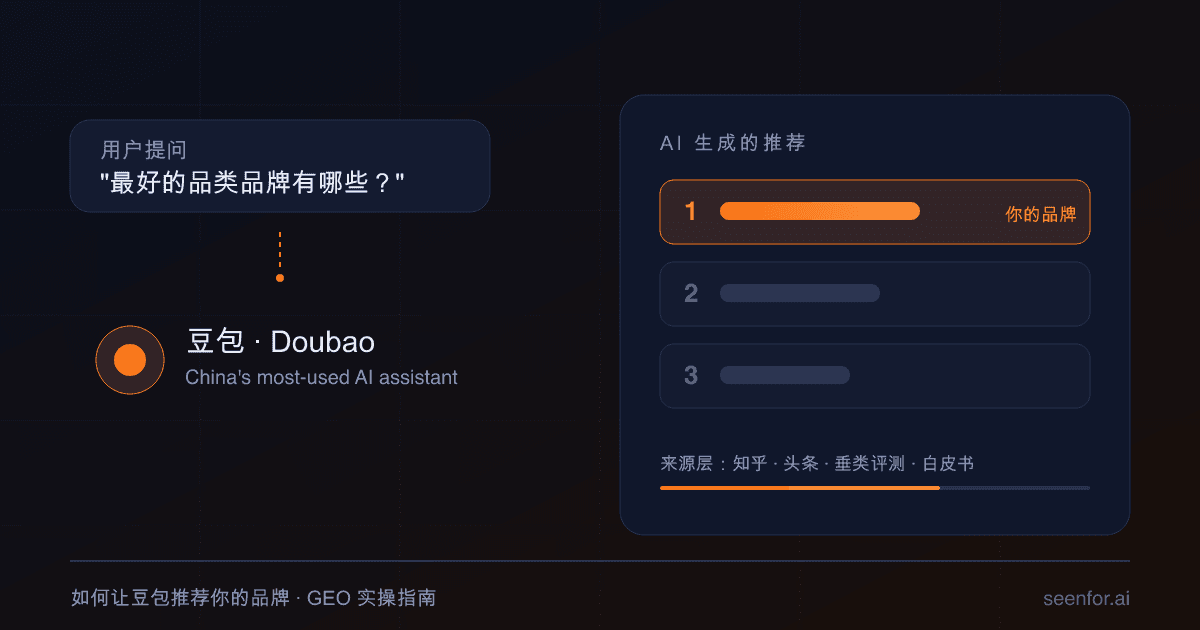
How to Get Doubao to Recommend Your Brand: A GEO Playbook
Doubao is China's most-used AI assistant. Here's how it picks the brands it recommends, which sources it trusts, and five actions brands can take.
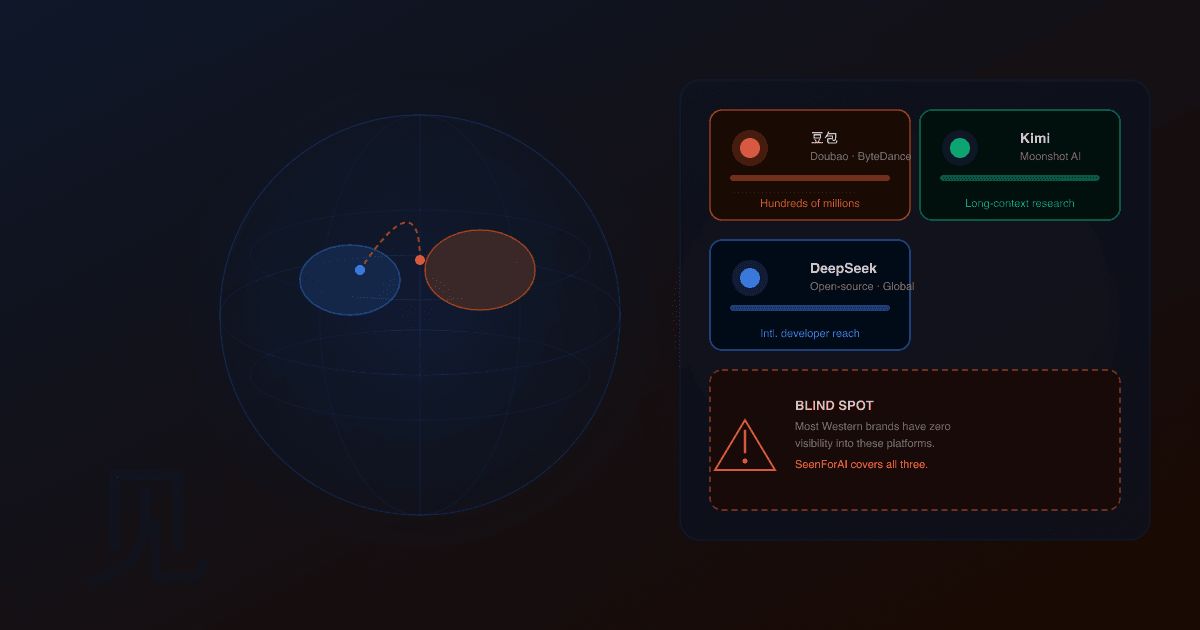
Why Chinese LLMs Matter for Global Brands
Doubao, Kimi, and DeepSeek serve hundreds of millions of users — most Western brands have no idea what these models say about them.
Product Newsletter
Stay informed
Receive release notes, and workflow tips from SeenForAI.