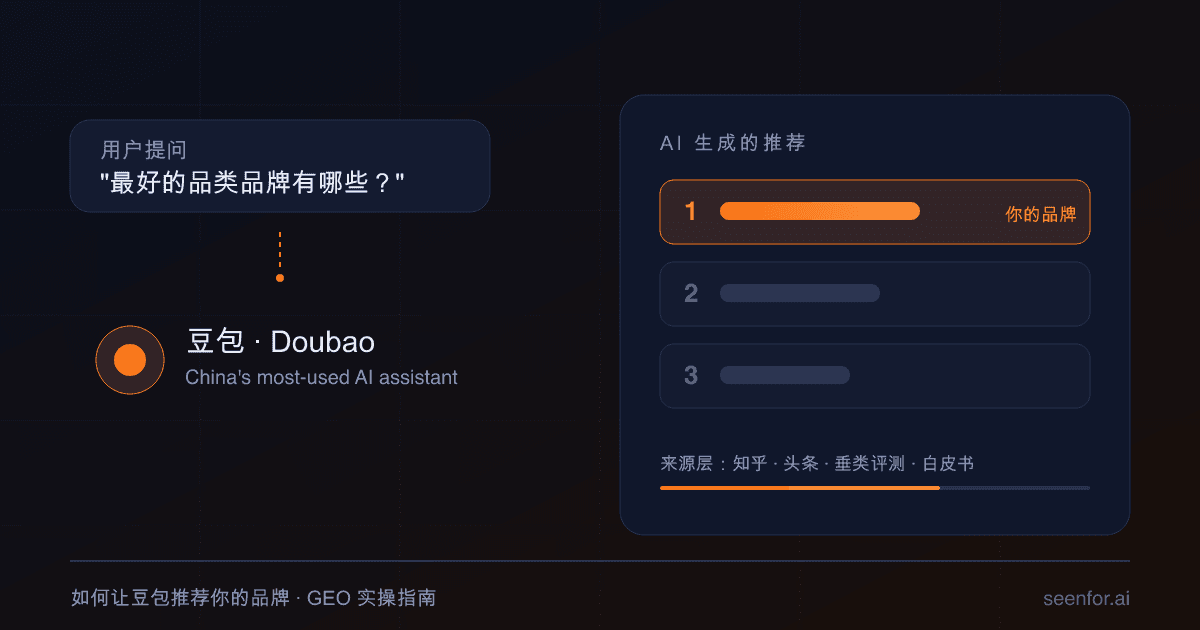
How to Get Doubao to Recommend Your Brand: A GEO Playbook
Doubao is China's most-used AI assistant. Here's how it picks the brands it recommends, which sources it trusts, and five actions brands can take.
"Which air fryer brand is best?" "What laptop should I buy with a ¥5,000 budget?" — tens of millions of questions like these go into Doubao every day. The two or three brand names in Doubao's answer are directly replacing a slice of search, discovery and price-comparison behavior in China.
If your brand isn't in the answer, users won't check "page two" — Doubao's answer has no page two.
How Doubao picks the brands it recommends
When Doubao (ByteDance / Volcano Engine) generates a recommendation, it draws on roughly three layers:
- Parametric knowledge: how your brand is described, rated and compared in the Chinese training corpus. Your share and framing in Chinese-language content decides what the model "remembers" about you.
- Live retrieval: for time-sensitive questions, Doubao retrieves web content before answering. Toutiao-ecosystem content, authoritative media, Zhihu and vertical review sites carry visible weight.
- Alignment and safety: brands that look ambiguous, contested or controversy-laden tend to be silently omitted — the model doesn't badmouth you, it just doesn't mention you.
For brands, that translates into three levers you can actually pull: corpus coverage, retrievable content, and entity clarity.
Five actions that work
1. Measure first: know what Doubao says today
You can't optimize without a baseline. Run the questions your buyers actually ask (category recommendations, competitor comparisons, "is X any good?") against Doubao and record: mentioned or not, ranking position, framing, and any factual errors.
2. Fix entity confusion
Common issues for brands in Chinese: brand names colliding with generic words, inconsistent Chinese/English naming, murky parent-brand relationships. Make sure your website, encyclopedia entries and authoritative press use identical naming and positioning — the more confident the model is about who you are, the more willing it is to recommend you.
3. Build coverage in Doubao's source layer
Doubao's retrieval pool looks nothing like Google's: expert Zhihu answers, vertical media reviews, in-depth Toutiao content, industry white papers. One strong Zhihu category-comparison answer can move your Doubao visibility more than ten blog posts on your own site.
4. Write structured, quotable content
Models prefer statements they can lift directly: concrete specs, clear audience fit ("best for small teams", "top pick under ¥3,000"), honest pros-and-cons. Marketing superlatives ("industry-leading", "ultimate experience") get dropped at generation time.
5. Monitor continuously and watch for hallucinations
Doubao's answers shift with every model version and retrieval pass. Wrong prices, misattributed features, or your brand blended with a competitor's — the earlier you catch these hallucinations, the easier they are to correct with content fixes.
Don't stop at Doubao
The same buyer questions are being asked on Kimi and DeepSeek, and each model trusts different sources. Chinese AI visibility is a portfolio problem, not a single-model problem.
SeenForAI runs your prompt set daily across Doubao, Kimi and DeepSeek plus ChatGPT, Claude, Gemini and Perplexity — tracking Share of Voice, sentiment and hallucinations. Or start with the free AI Visibility Checker to see in one minute how Doubao answers questions about you today.
Doubao's answers are being generated every day. The only question is whether you're in them.
Further reading
Author

Categories
More Posts
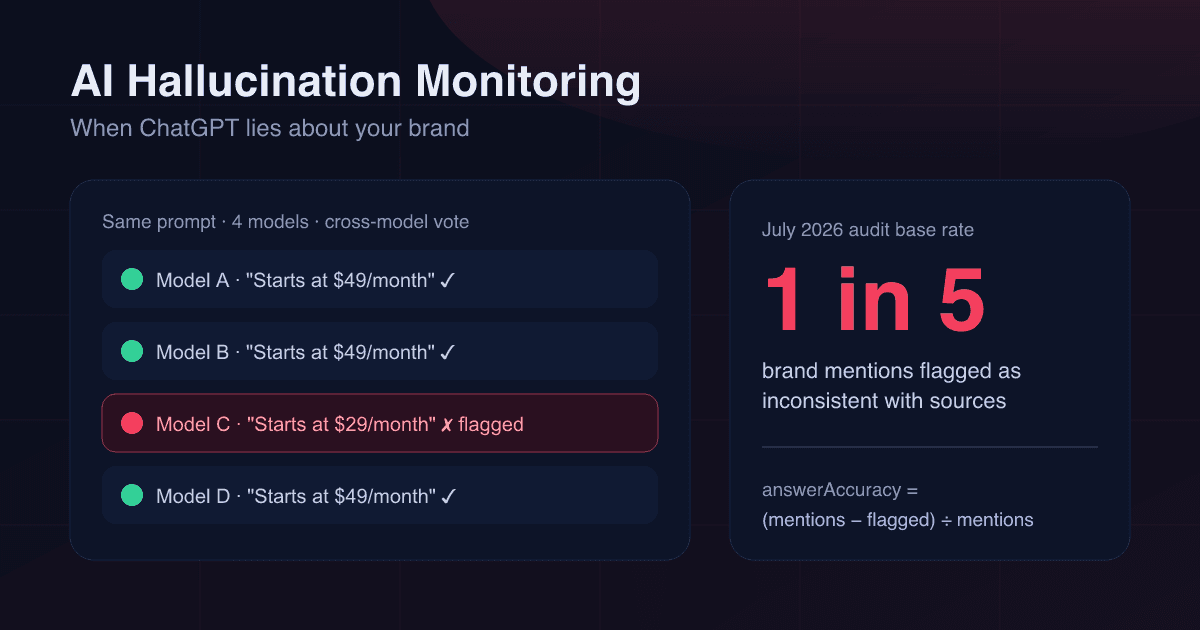
AI Hallucination Monitoring: When ChatGPT Lies About Your Brand
LLMs confidently invent pricing, features and even founders. How to detect brand hallucinations — and the multi-model voting method that verifies them.
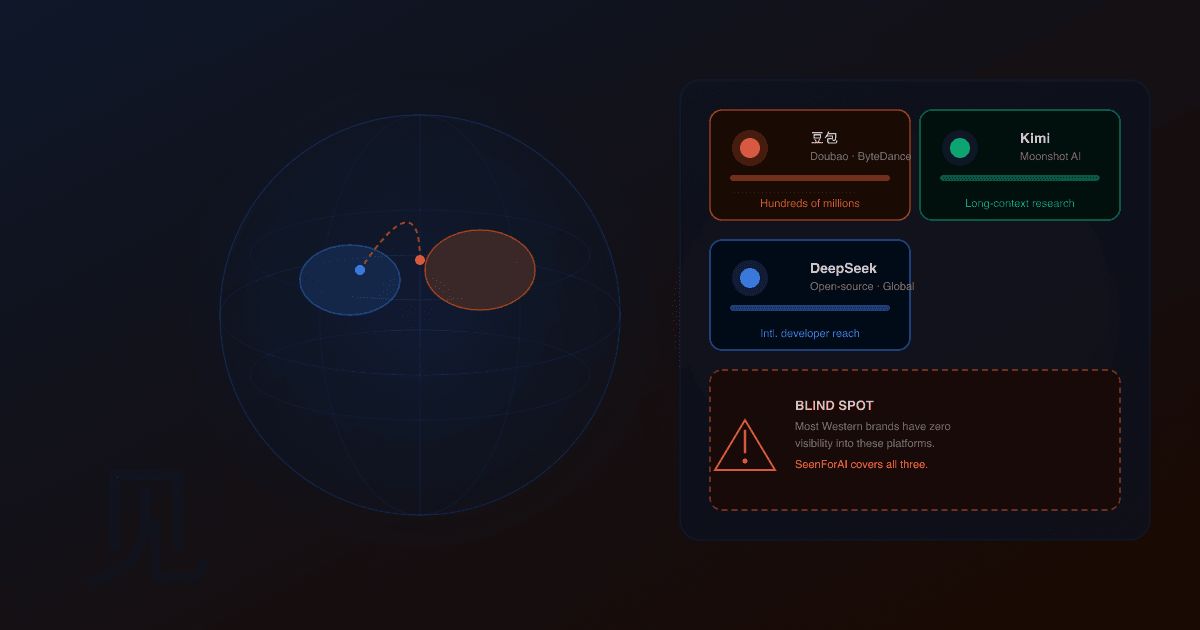
Why Chinese LLMs Matter for Global Brands
Doubao, Kimi, and DeepSeek serve hundreds of millions of users — most Western brands have no idea what these models say about them.
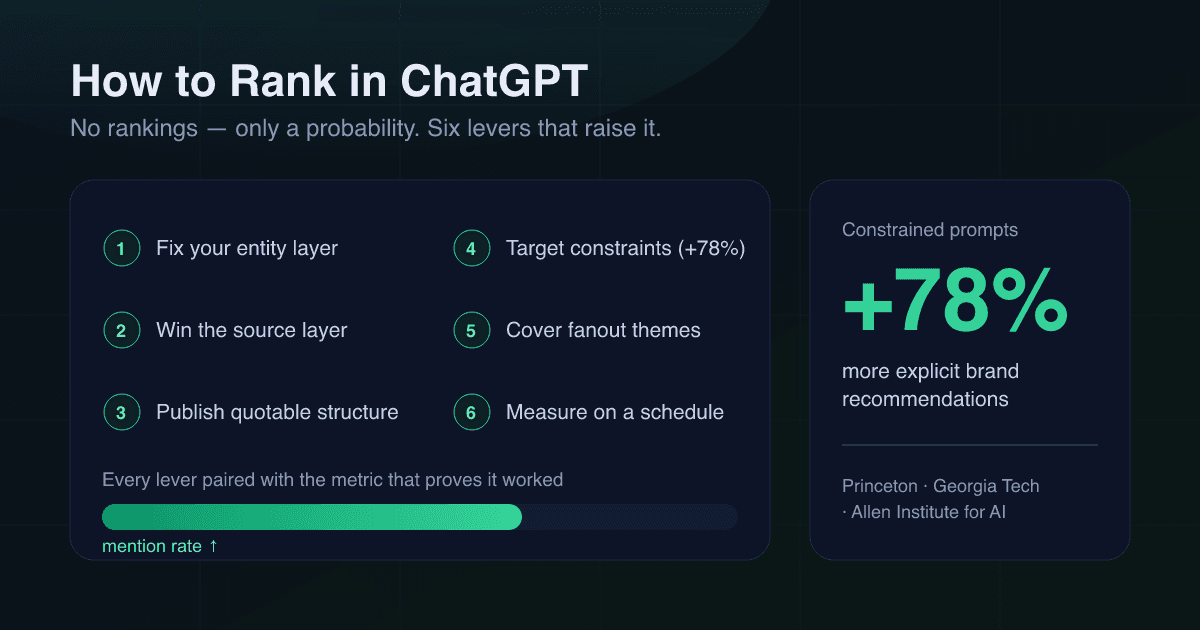
How to Rank in ChatGPT: A Measurable 6-Step Playbook (2026)
ChatGPT has no rankings — only a probability your brand gets named. Six levers that raise it, with data on what actually moves the needle.
Product Newsletter
Stay informed
Receive release notes, and workflow tips from SeenForAI.