Mention vs Citation: The Share of Voice Split Most GEO Dashboards Get Wrong
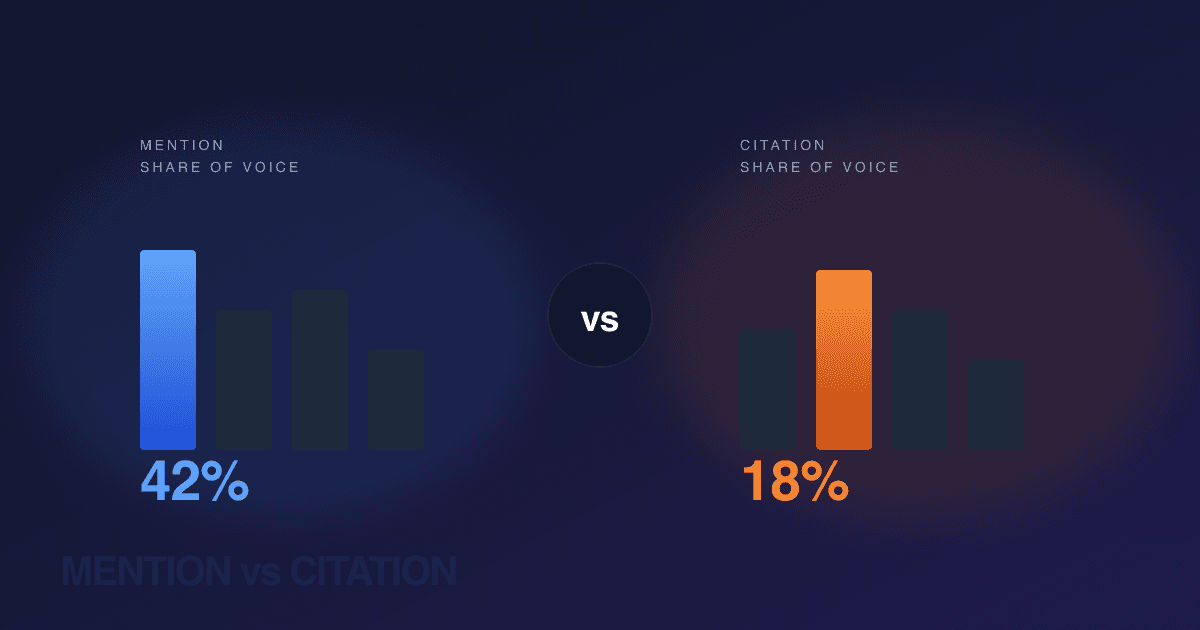
ChatGPT mentions your brand in prose but cites your competitor's docs underneath. Which signal counts? Both — but they tell you completely different things, and most dashboards only show one.
Here's a real shape we see all the time in AI-search telemetry: ChatGPT answers a category question, names your brand in the second paragraph, and then cites four URLs at the bottom — none of which are yours. To a casual reader the answer "mentions" you, so it feels like a win. To the analytics layer measuring the citation graph, you're invisible.
Both readings are correct. They're measuring different parts of the funnel.
Mention-based SoV and citation-based SoV are not the same number
When the GEO category started, almost everyone reported one number: mention-based Share of Voice. Count how often your brand name appears in the answer text across a prompt set, divide by total brand mentions across all competitors, and call that your share. It's intuitive, it's what humans read first, and it's what the chart on the homepage of every GEO landing page actually shows.
Then a few platforms — Conductor was the first to make a UI feature of it, Profound treats it as a flagship analytic — started exposing a separate number: citation-based Share of Voice. Same prompt set, but instead of counting prose mentions, count which URLs the LLM linked to or grounded against, normalised to domain. What share of cited sources are yours, or talk about you, vs your competitors'?
These two numbers diverge more often than people expect, and the divergence is the signal.
Two real divergence patterns, and what each one means
Prose-mention strong, citation weak. The LLM names you confidently in the answer but the URLs underneath belong to competitors and third parties who happen to mention you. What's almost certainly going on: the model remembers you from its training data — probably from a period when you were getting a lot of press, podcast mentions, or just heavy mid-2024 coverage — but the current retrieval layer can't find authoritative pages about you to cite. You won the past. You're losing the present.
The fix isn't more brand-name placement; the LLM already knows you exist. The fix is making sure that when the model goes looking for a source to cite for a claim about your category, your docs, your changelog, or a Reddit thread about you exists and is fresh enough to surface.
Prose-mention weak, citation strong. The mirror image: your URLs show up in the citation list (your docs, your blog, your G2 listing) but the answer text talks about a competitor. What's happening: the model treats you as a source of truth — it'll quote your benchmarks, your definitions, your terminology — but doesn't surface you as a named option in the answer. You're being used as Wikipedia. You're not being used as a vendor.
The fix here is different too. The brand-name problem isn't an authority problem — your content is already authoritative enough to cite. It's a positioning problem: somewhere in the corpus you're being filed as "neutral reference" rather than "buyable answer to this category". That's a content-framing and category-language problem, not a backlink problem.
Why most dashboards still only show one of these
Pure mention-based SoV is easy. You can compute it from raw response text with a regex and a brand-synonym list — no provider-specific work, no normalization layer, no domain-grouping logic. The cost to build is low; the cost to read is low; it goes on the dashboard.
Citation-based SoV is harder because every LLM provider hands citations back differently. Perplexity returns a clean citations array. Gemini-with-grounding gives you groundingChunks. OpenAI's web-search tool returns a urls field on certain responses. Some answers have no structured citations at all and you're parsing inline links out of Markdown. Then you have to normalise the URLs to domains, group them into categories (Reddit vs Wikipedia vs comp-site vs your own), and decide which brand each domain "represents". It's real engineering work, and it's why the field is still split between tools that ship it and tools that don't.
The shortcut some dashboards take — "citations" as a tab of raw URLs with no SoV view on top — isn't a substitute. A scrollable list of links isn't a metric.
How to actually read the gap between the two
If your tool shows both numbers, treat the delta as the most interesting thing on the page.
A 10-point gap in either direction is a strategy signal. Mention way above citation? Your brand awareness is doing the work and your owned/earned source layer is not — invest in the source layer. Citation way above mention? Your content is doing the work but the model isn't connecting your name to the category — invest in category language, comparison content, and explicit positioning.
A small gap means the two layers of your AI-search presence are roughly in sync; the brand reads how you'd expect from both prose and sources. That's the boring, healthy state.
What this looks like in SeenForAI
This is part of why we surface mention-based and citation-based Share of Voice as two side-by-side numbers on the dashboard, not one blended score. Blending them sounds tidier but it discards the signal — the gap between the two is where the actionable strategy lives.
If your current GEO tool only shows one number, you're not getting half the picture wrong. You're getting half the picture missing. Worth checking which half.
Further reading
More Posts
How to Track Your Brand Mentions in ChatGPT
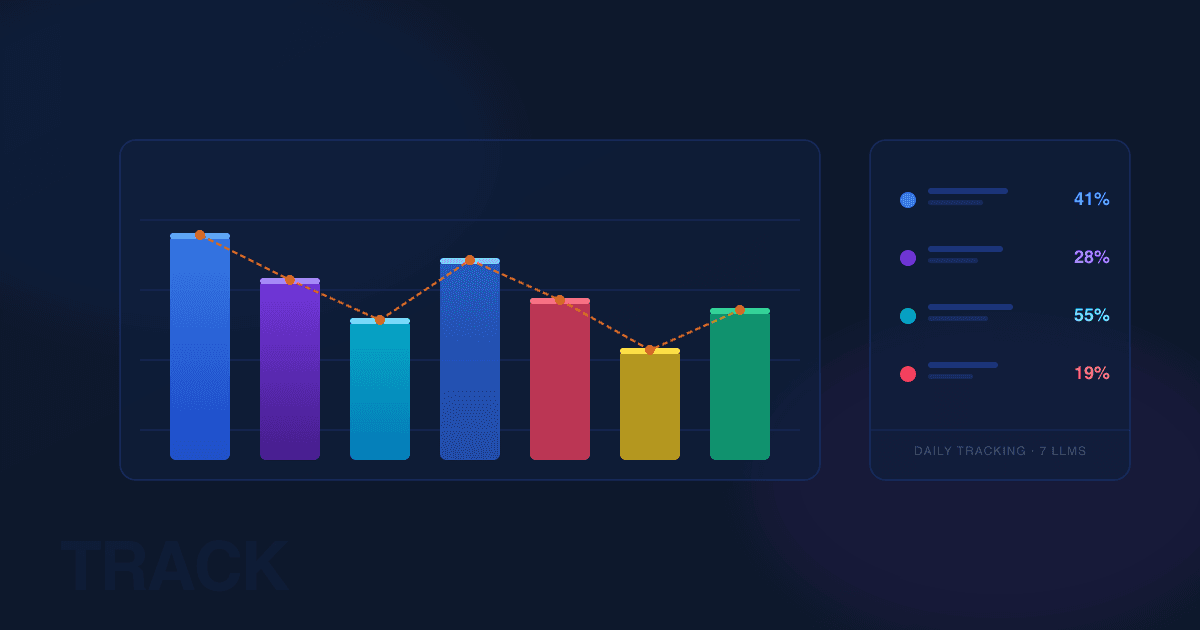
GA4 won't show you LLM referrals. Here are three approaches to tracking your brand in ChatGPT — and when each one makes sense.

Reddit, Wikipedia, and the Hidden Source Layer Shaping AI Answers
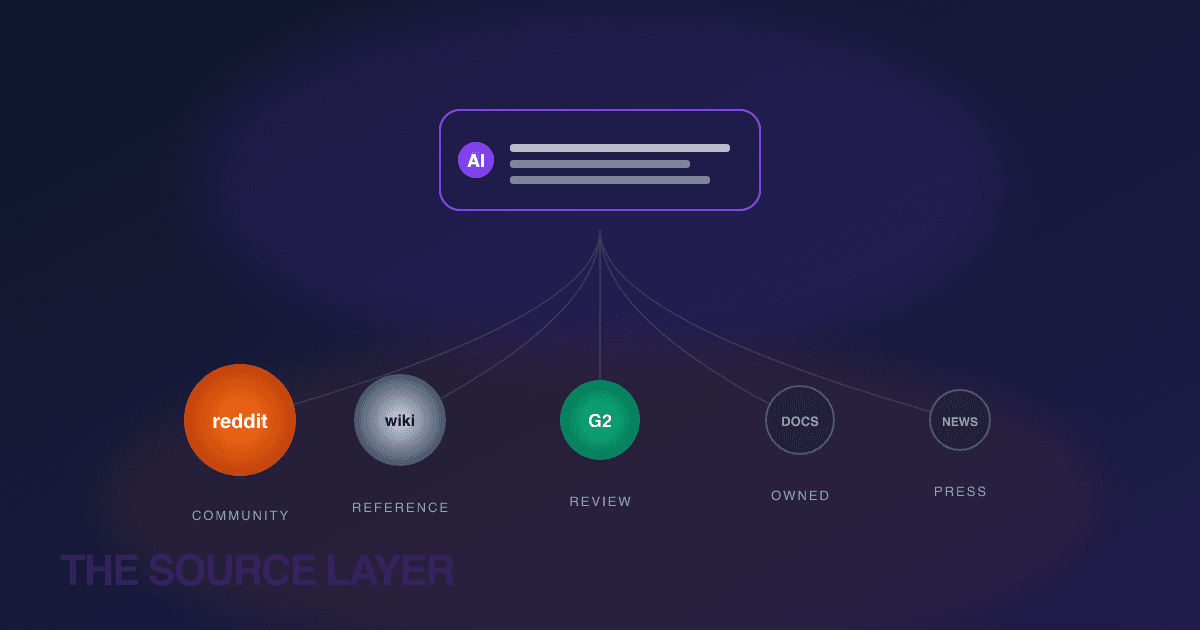
When ChatGPT recommends a vendor, look at what it cites. For most B2B categories the citation list is dominated by Reddit threads, Wikipedia infoboxes, and a handful of comparison sites — not the product pages brands spend most of their time on.
The 35/35/30 Rule for GEO Prompt Sets
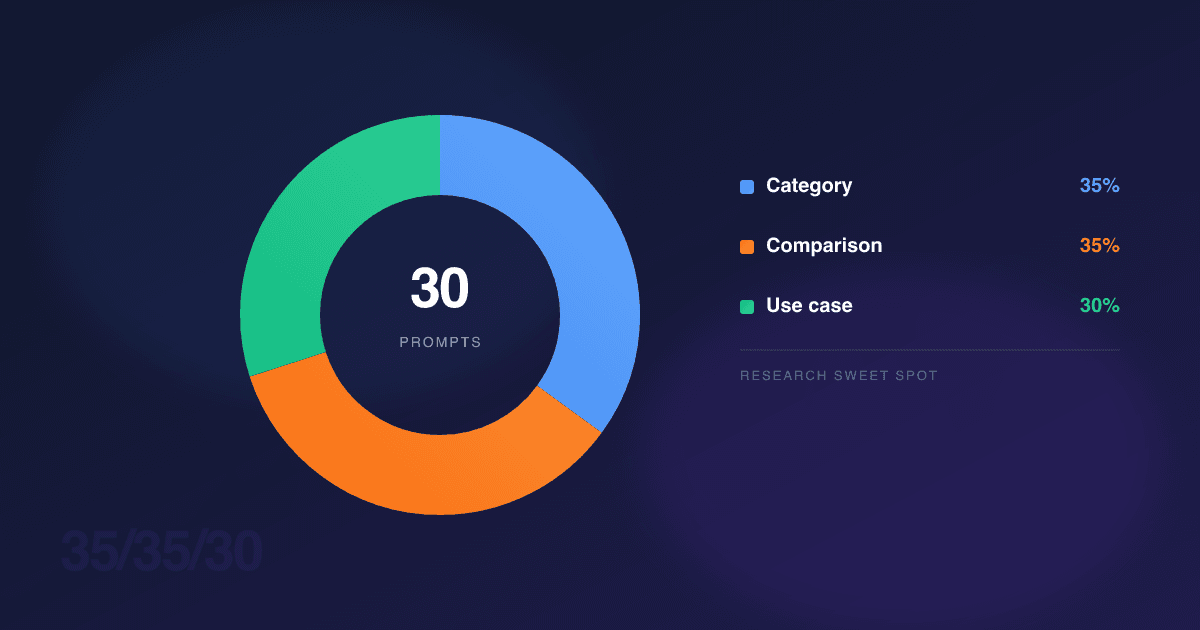
Why 30 prompts is the noise floor for AI visibility tracking, and how to balance category, comparison, and use-case prompts so your dashboard shows signal instead of noise.
Product Newsletter
Stay informed
Receive release notes, and workflow tips from SeenForAI.