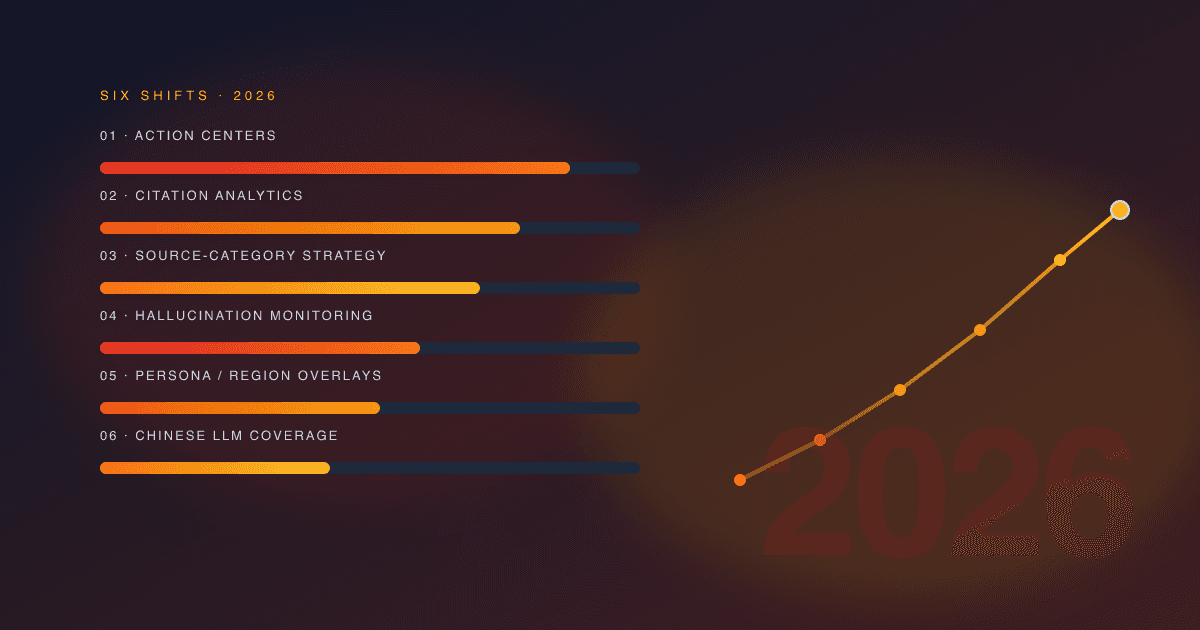
State of GEO 2026: Six Industry Shifts Shaping Brand AI Visibility
A year ago, "monitor my brand in ChatGPT" was a niche request. In 2026 it's a budget line. Here are the six shifts that defined the year for brands measuring AI visibility.
Twelve months ago, "track how ChatGPT talks about us" was a side-project someone on the growth team brought up at offsites. Today, AI-search visibility shows up in marketing OKRs, on Q-review slides, and in board updates. The tools, the metrics, and the playbook have all moved.
Here are the six shifts that defined GEO's 2026.
1. Action Centers are eating dashboards
The biggest UX shift across the category. First-gen tools showed teams what was broken; the new generation tells them what to publish next. AthenaHQ ships draft articles aimed at the prompts you're losing. Peec groups recommendations into a Reddit / Wikipedia / comparison-site action queue. The bet is that visibility insight without a paired content workflow has roughly the retention curve of any analytics product that requires the user to invent their own response — too low to compound.
Expect "we'll generate the next move for you" to be table stakes by the end of the year, and dashboard-only tools to feel dated.
2. Citation analytics has split from mention analytics
For the first generation of tools, Share of Voice meant one number: how often your brand's name appeared in the answer prose. That number is still useful, but the field is now consistently exposing a second one — citation-based Share of Voice, measuring which URLs the LLM grounded against, not just which names it mentioned.
The two numbers diverge often enough that treating them as one is a real loss of signal. Conductor was first to make this a UI feature; Profound treats it as flagship; we surface them side by side at SeenForAI. If you're reading a dashboard that only shows one, you're guessing about a different half of the funnel than you think.
3. Source-category strategy is beating product-page polish
The single most consistent finding across GEO citation-graph analyses: for most B2B categories, Reddit threads, Wikipedia articles, and a small recurring set of comparison sites disproportionately shape what the LLM cites. Brand-owned domains land further down the list than marketers expect for category-level discovery.
The strategic implication is taking time to settle but it's clear: investing in a substantive Reddit answer, an accurate Wikipedia infobox, or a current G2/Capterra listing is producing more AI-visibility lift right now than another product-page rewrite. The marketing org chart hasn't caught up to this yet — most teams still spend the bulk of their writing time on owned-domain content. The teams that have noticed are quietly winning prompts.
4. Hallucination and brand safety moved from edge case to monitored metric
In 2025 most teams discussed LLM hallucinations as a fun anecdote in keynote slides — "ChatGPT said our company was founded in 2007 and our HQ is in Helsinki, neither of which is true." In 2026 hallucination detection is a feature in the product, not a slide.
The pattern that's stuck is cross-model voting: when 5 of 7 LLMs agree on a fact about a brand and 2 disagree, the disagreeing 2 are likely confabulating. BrandRank and Bluefish push real-time alerts when a hostile or factually wrong answer appears. We use cross-model voting plus brand-fact checklists on the roadmap. Expect "hallucination rate" to be a number on your monthly marketing report by Q4.
5. Persona and region overlays are no longer experimental
The same prompt run as "as a CFO" returns a measurably different shortlist than as "as a startup founder". The same prompt run with US routing vs APAC routing returns different answers from any model that grounds against region-specific retrieval. Persona-overlay and region-overlay scanning was an oddity in late 2025; in 2026 it's how serious GEO programs are run.
The implications for buyers: a single global SoV number, with no persona or region breakdown underneath it, is hiding the variance that actually matters. Your enterprise pipeline and your SMB pipeline are not seeing the same answers. Your US buyers and your APAC buyers are not seeing the same answers. Measuring those separately is the difference between "the chart says we're doing fine" and "the chart says we're doing fine because the bad cohorts are averaged out."
6. Chinese LLM coverage as the APAC wedge
This one matters more for some brands than others, but for any company selling into Asia-Pacific it's quietly become a budget question. Doubao (ByteDance), Kimi (Moonshot), and DeepSeek now serve real query volume from Chinese-speaking buyers, and their answers diverge from ChatGPT/Claude in meaningful ways — different consensus shortlists, different cited sources, sometimes different competitive narratives entirely.
The western GEO platform field has been slow to cover them. Most of the established tools monitor four to six western models and stop there, which means a brand running a "global" AI-visibility program is in practice measuring a North-Atlantic AI-visibility program. We monitor all three on SeenForAI as a deliberate wedge for APAC-facing brands; expect more of the field to follow as the gap becomes a buying objection.
What's next
Six shifts in one year is a lot of motion for a category that didn't have a name eighteen months ago. The trajectory is clear: GEO is moving from "how often is my name in the answer" toward "what do I publish, where, in which voice, to which persona, in which region, to move the answer." Less measurement; more workflow.
If your AI-visibility setup today is a dashboard you check on Mondays, that's where the category was in 2025. The work for the rest of 2026 is upgrading the workflow underneath it.
This is the direction we're building toward at SeenForAI — coverage across all seven LLMs (including the Chinese trio), mention + citation Share of Voice side by side, source-category analytics, and an Action Center as the next leg of the roadmap. If any of the six shifts above sound like they belong in your Q3 plan, we'd like to be the tool you measure them on.
Further reading
Author

Categories
More Posts
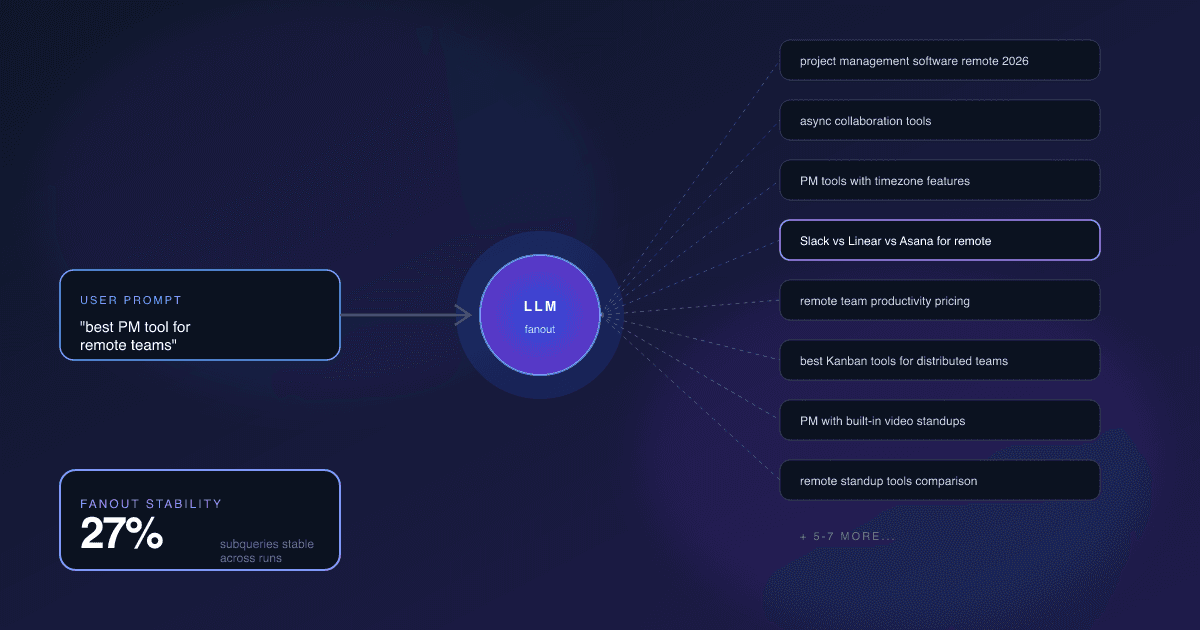
Query Fanouts: The Hidden Layer of AI Search That Decides Your Visibility
When a user asks ChatGPT or Gemini one question, the model silently runs 8-15 sub-queries behind the scenes. Whether your brand appears in those hidden searches is what really determines your AI visibility.
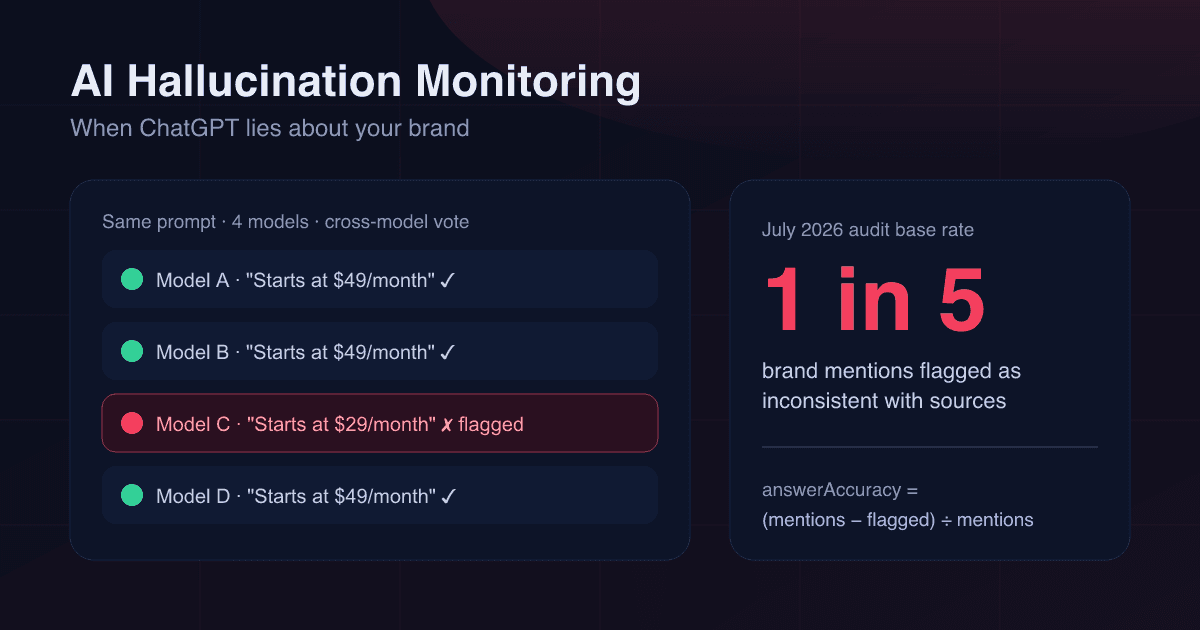
AI Hallucination Monitoring: When ChatGPT Lies About Your Brand
LLMs confidently invent pricing, features and even founders. How to detect brand hallucinations — and the multi-model voting method that verifies them.
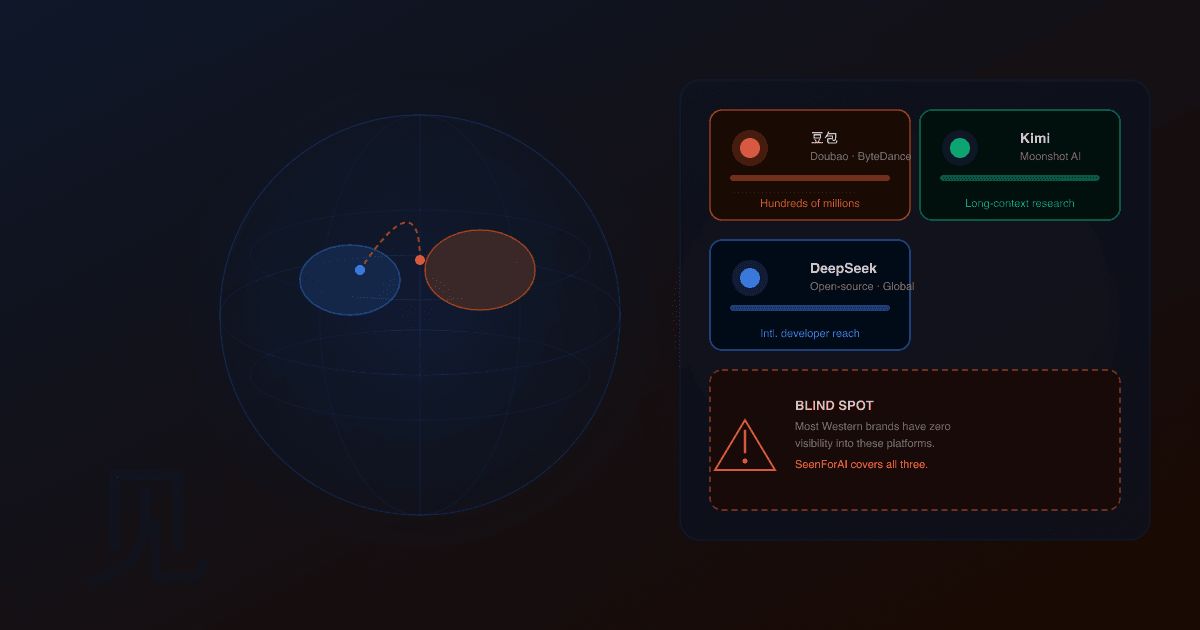
Why Chinese LLMs Matter for Global Brands
Doubao, Kimi, and DeepSeek serve hundreds of millions of users — most Western brands have no idea what these models say about them.
Product Newsletter
Stay informed
Receive release notes, and workflow tips from SeenForAI.